BABY
When Do Babies Start Sleeping Through the Night?
You may have heard that most babies start sleeping through the night at 3 months old. Guess what? That is mostly untrue! Learn when you can really expect your baby to snooze all night long.

Written by
Happiest Baby Staff
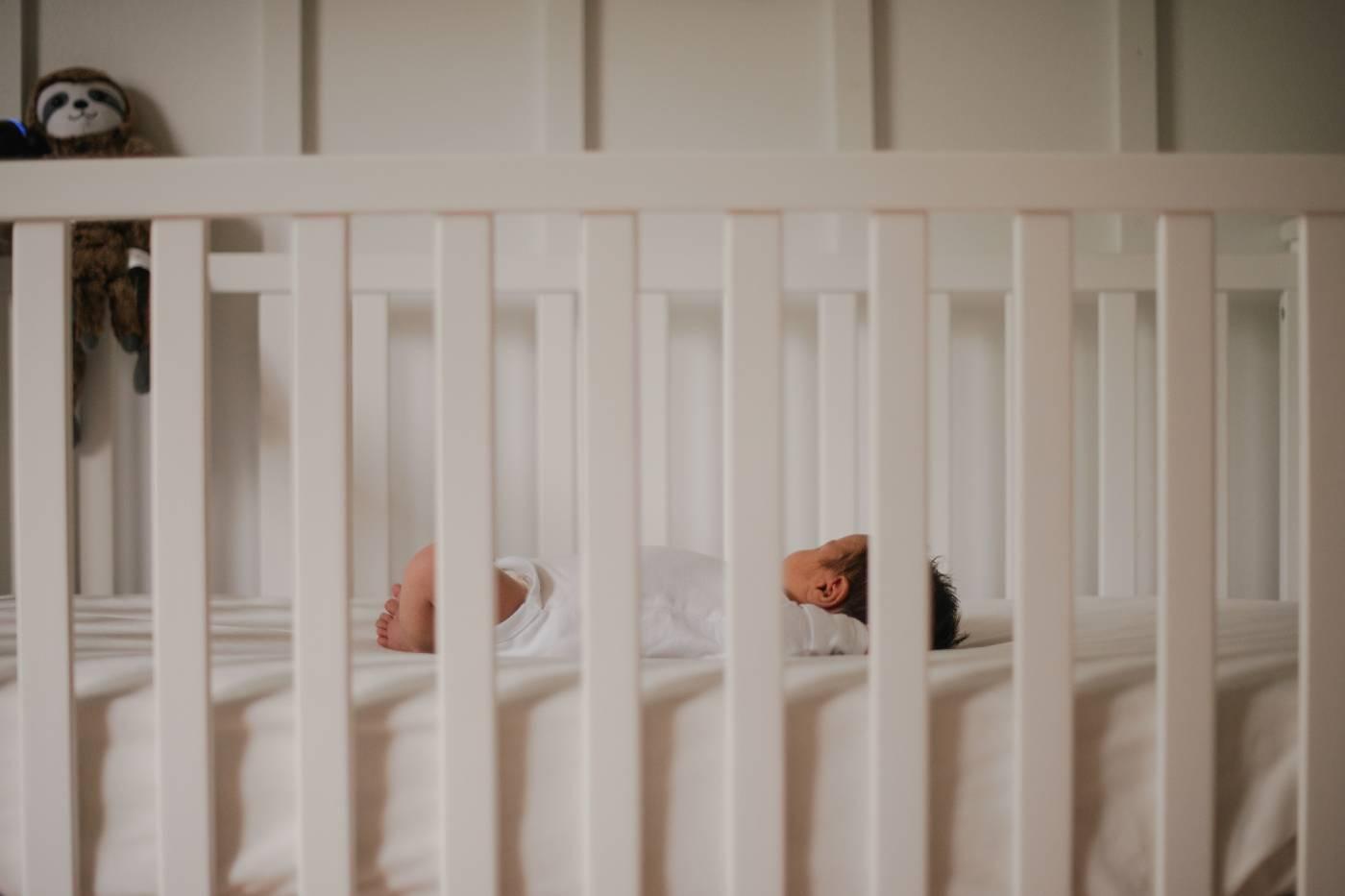
Parents have a lot of questions about sleep: Should you wake a sleeping baby to eat? Why is my sleeping baby so noisy? How do I handle sleep regression? But the most-asked baby sleep question is always the same: When will my baby start sleeping through the night? And its popularity is totally understandable: On average, a new parent loses 133 minutes of sleep every night for the first year of their baby’s life. Parents are tired! And they are desperate to learn when their precious uninterrupted nighttime sleep will return. The truth is that it takes time. But your baby will eventually—and gradually—hit that sleeping-all-night sweet spot. Read on to find out when most babies sleep through the night—plus tips for getting them there.
What does 'sleeping through the night' mean?
For babies, 'sleeping through the night' generally means snoozing for at least six continuous hours. However, within that stretch, babies may briefly wake…but they are able self-soothe themselves back to sleep without parental help. And, honestly, that last bit is the key. You see, all of us—babies, toddlers, big kids, and adults—whether we realise it or not, rouse a tiny bit about three to four times a night. So, the goal for your baby is not necessarily to 'sleep through the night,' but to help them learn how to self-soothe, so when they inevitably wake, they can get back to dreamland on their own.
When do most babies sleep through the night?
Brace yourself: While parents are often told that most babies start sleeping through the night at about 3 months old, that is not entirely accurate. At this time, your baby’s bedtime shifts a bit earlier (around 9pm) and they may clock between five and eight hours of sleep…but they are still waking for a feeding or two. Moreover, a 2018 study of close to 400 babies found that a large percentage of healthy babies still are not sleeping through the night at a year old. Here is the breakdown:
- At 6 months old: About 62% of infants were sleeping 6 hours a night and 43% were sleeping for 8-hour stretches.
- At 12 months old: Roughly 72% of babies were snoozing for 6 hours in the evening and about 57% were sleeping for 8.
One exception? The constant and calming womb-like motion and sound of SNOO Smart Sleeper has shown to help most babies 'sleep through the night' (meaning seven to eight hours of sleep) at 3 to 4 months!
Why won’t my newborn sleep through the night?
Newborns need a lot of sleep—about 16 hours a day, in fact. But those ZZZs do not come in long swaths…or necessarily happen at night. Instead, newborn sleep occurs in smaller chunks throughout the day and night because:
- Newborns’ tummies are teeny, so they get hungry a lot. Breastfed newborns eat about every two to three hours and formula-fed babies need to be fed every three to four hours.
- Newborns’ natural day-night circadian rhythms have not developed yet.
- Newborns’ sleep cycles last a mere 45 to 50 minutes, which means they return to very light—easily disturbed—sleep almost every hour, making them more vulnerable to wakeups.
If your baby will not sleep through the night, then try...
While newborn babies are not expected to sleep through the night, white noise and swaddling work wonders to help young babies sleep well. In fact, they are both essential elements of the 5 S’s for soothing babies—and getting them to rest. The gentle hug of a swaddle mimics the security of the womb, it decreases startling, and it increases sleep. Plus, wrapped babies respond faster to the other S’s, including shushing (white noise), further helping babies sleep. And the womb-like sounds of white noise has shown to help 80% of babies fall asleep in just five minutes.
Why won’t my 3-month-old sleep through the night?
By 3 or 4 months, most babies’ brains are mature enough to sleep for at least a six-hour stretch without needing to be fed…but that does not necessarily mean they will not wake throughout the night anymore! Babies often experience a 3- to 4-month sleep regression where your small snoozer suddenly starts to wake up like a newborn every few hours—and now wants to play or cuddle, refusing to sleep alone. This happens for a few reasons, namely:
- Hunger: Consider adding a dream feed to the mix, where you gently rouse your baby (without fully waking) to feed one more time before you turn in for the night.
- Starting to roll over: When that happens, you must stop swaddling, which may mean your baby cries and wakes more often. (Babies in SNOO can remain safely swaddled until 6 months old.)
- Still learning to self-soothe: Establishing a consistent and calming bedtime routine that includes dim lights and some strong, rumbly white noise will help Baby learn to self-soothe. The constant, womb-like sound has proven to help babies fall asleep—and stay asleep.
- Teething: The mild ache can keep babies from falling asleep and wake them, too. (White noise is great at helping to distract babies from their teething pain.)
- More alert during the day: Your little one is now so much more aware of the big, exciting world around them and does not want to miss a thing! Plus, your baby is now more sensitive to temperature and light.
Why won’t my 6-month-old sleep through the night?
Remember the stats above? Research shows that more than half (57%) of 6-month-olds are not sleeping for 8 hours a night. And almost 40% are not even clocking 6 hours of sleep a night. The reason? Just like with the 3- to 4-month sleep regression, at 6 months old, babies experience several development milestones (Laughing! Learning to sit! Recognising your familiar face!) and teething issues that may be keeping them up. In addition, there is a chance your baby is…
- Still working on self-soothing: Again, it is important to establish a calming bedtime (and pre-bedtime) routine that includes using a strong, rumbly white noise all night long. The constant, womb-like sound is a wonderfully effective sleepytime cue, which helps your baby learn to self-soothe. Plus, white noise muffles internal and external sleep-sappers (like a slight teething pain and a loud telly).
- Falling asleep out of the cot: If your baby, say, fell asleep in your arms, but awakens in their cot, a light wake up can quickly morph into waking all the way up…especially if they have not learned how to self-soothe.
- Going to bed too early: If your baby fights falling asleep for 30 to 60 minutes, shows no sign of fatigue at bedtime, and wakes up in the middle of the night (or very early the next day) raring to go, try pushing your routine 15 minutes later every two to three nights to nail the right bedtime.
- Going to bed too late: If your little one takes super-long naps, easily dozes in the car or stroller during the day, is moody and irritable, and fights falling asleep for 30 to 60 minutes even though they are rubbing their eyes, blinking, or yawning at bedtime, try pushing their routine 15 minutes earlier every two to three nights to zero in on the best bedtime.
- Not napping enough: If your baby is taking two naps a day and is fussy in the early evening, consider adding a third 45-minute catnap into Baby’s schedule, starting at about three hours before lights out.
Why won’t my 8-month-old sleep through the night?
Babies between 8 and 10 months old may suddenly start to wake up once, twice…even three times a night! This is known as the 8- or 9-month sleep regression, and it is usually related to big developmental or physical changes your little one is going through, like:
- Greater mobility: Beginning to learn to crawl, walk, and explore is all so exciting! So exciting, in fact, that the thrill of what is next can keep little ones up at night.
- Discomfort: If your baby is waking every two hours, look for any external factors, like itchy pajamas or a bright light shining in the window that may be causing wakeups.
- Teething: Often, the 8-month sleep regression is caused by teething. Excessive drooling and red gums are a dead giveaway.
- Unique temperament: Super social babies may wake up more often than other babies because they are just too excited and want to 'talk' to you!
- Hunger: While your baby is busy filling up on new foods, it is important not to skimp on breastmilk or formula, which is important for energy and nutrients during the first year, and should be your child's main drink until 12 months.
- Trouble self-soothing: A calming and predictable bedtime routine is a must. Dim the light an hour before lights-out, read stories, offer a relaxing bath or massage…and again, make sure you play a strong, rumbly white noise all night long.
How to Help Baby Start Sleeping Through the Night
To set your baby up for sleep success from the get-go, ensure that they are as comfortable as possible and getting the natural light they need. That means…
- Expose your baby to natural outdoor light during the day. (Morning and afternoon light helps to regulate levels of their sleep hormone, melatonin, ensuring that they will be sleepy when they should be.)
- Feed your baby before night-night so they go to bed with a full tummy.
- Change Baby’s nappy before bed.
- Keep your little one’s room between 20 and 22 degrees Celsius (this prevents overheating), and make sure they are dressed warmly enough (the rule of thumb is to put them in one more layer of clothing than you).
- Place your baby to sleep on their back in their own bare sleep space with no soft, loose objects.
- Keep your baby’s room dark, except for a dim night light.
The 5 S’s and Babies Sleeping Through the Night
All babies are born with a built-in calming reflex, which is nature’s 'off switch' for crying and 'on switch' for sleep. To find that switch, parents need to enlist the help of the famed 5 S’s, which are proven soothing techniques that work to help babies sleep. In short, the 5 S’s mimic the rhythms and sensations Baby experienced inside the womb and can now be used as sleep cues to help settle them to sleep. They are:
- Swaddling: Babies should be swaddled until they are able to roll. (Again, SNOO babies can remain safely swaddled for up to 6 months.) The gentle pressure of a swaddle decreases startling and arm flailing that can wake babies, and it helps babies better focus on other sleep soothers, like white noise.
- Shushing: Babies hate sleeping in silence! Instead, they prefer the constant rumble of white noise (aka shushing). But do not use a hissy fan and ocean sounds. The best white noise for sleep is continuous, monotonous, low pitch, and mimics the loud rumble of the womb. (The Happiest Baby SNOO sounds download, the award-winning SNOO bassinet, and/or SNOObear all deliver the just-right white noise.)
- Swinging: It is jiggly in the womb and that is why slow rocking helps keep babies calm and faster, tiny motions can soothe a crying infant. (SNOO offers safe all-night rocking and responds to your baby's fussing with the just-right amount of movement.)
- Sucking: Many fussy babies relax into a deep tranquility when they suck. It lowers their heart rate, blood pressure, and stress levels. Once breastfeeding is well established, feel free to introduce a dummy to your little one’s night-night routine.
- Side or Stomach Position: This S can be activated by holding your baby on their side, stomach, or over your shoulder. It is meant solely for soothing, not sleep. On the back is the only safe sleep position for Baby.
Sleep Training to Help Babies Sleep Through the Night
Young infants need to wake every two to four hours to feed. And they are simply not developmentally ready for super-long stretches of nighttime sleep. And that is why traditional 'cry it out' sleep training is inappropriate for babies who are 3 months old or younger. Generally speaking, when babies are between 4 and 6 months old, they are developmentally ready for that type of sleep training. However, there is a gentler approach that can be used earlier: The wake-and-sleep sleep training method. Here is the gist:
- Every bedtime, swaddle your baby, turn on the white noise, feed and burp them, and let them fall asleep in your arms before you lay them down in their bassinet (safely on their back).
- Right after you put your baby down, gently rouse them with a light tickle on their feet until they barely open their eyes. After a few seconds, they will close their eyes again and slide back to sleep.
- If your little one fusses, pick them up for a feed or a cuddle, then repeat the gentle-tickle-to-wake routine.
While waking a sleeping baby seems like the worst idea ever—it is not! Those few seconds of drowsy waking are the first steps to helping your baby learn how to self-soothe and sleep through the night.
Disclaimer: The information on our site is NOT medical advice for any specific person or condition. It is only meant as general information. If you have any medical questions and concerns about your child or yourself, please contact your health provider. Breastmilk is the best source of nutrition for babies. It is important that, in preparation for and during breastfeeding, mothers eat a healthy, balanced diet. Combined breast- and bottle-feeding in the first weeks of life may reduce the supply of a mother's breastmilk and reversing the decision not to breastfeed is difficult. If you do decide to use infant formula, you should follow instructions carefully.






SHARE THIS ARTICLE
PARENT PICKS
Bestsellers