TODDLER
How Kids Learn to Draw
It is not scribbles and squiggles forever! Find out exactly when (and how) your budding Picasso’s drawing skills develop and grow.

Written by
Happiest Baby Staff
SHARE THIS ARTICLE
PARENT PICKS
Bestsellers
TODDLER
Written by
Happiest Baby Staff
SHARE THIS ARTICLE
Bestsellers
Finger paints! Colouring books! Sketch pads and art kits! Oh, the creative fun in store for your budding artiste. It may be hard to tell right now, but your toddler or nursery schooler is busy honing the skills they need to create masterpieces down the road. Skeptical? Think about it this way: Even Frida Kahlo started out scribbling while holding a crayon in her fist! Here, what you can expect—and when—from your creative little one.
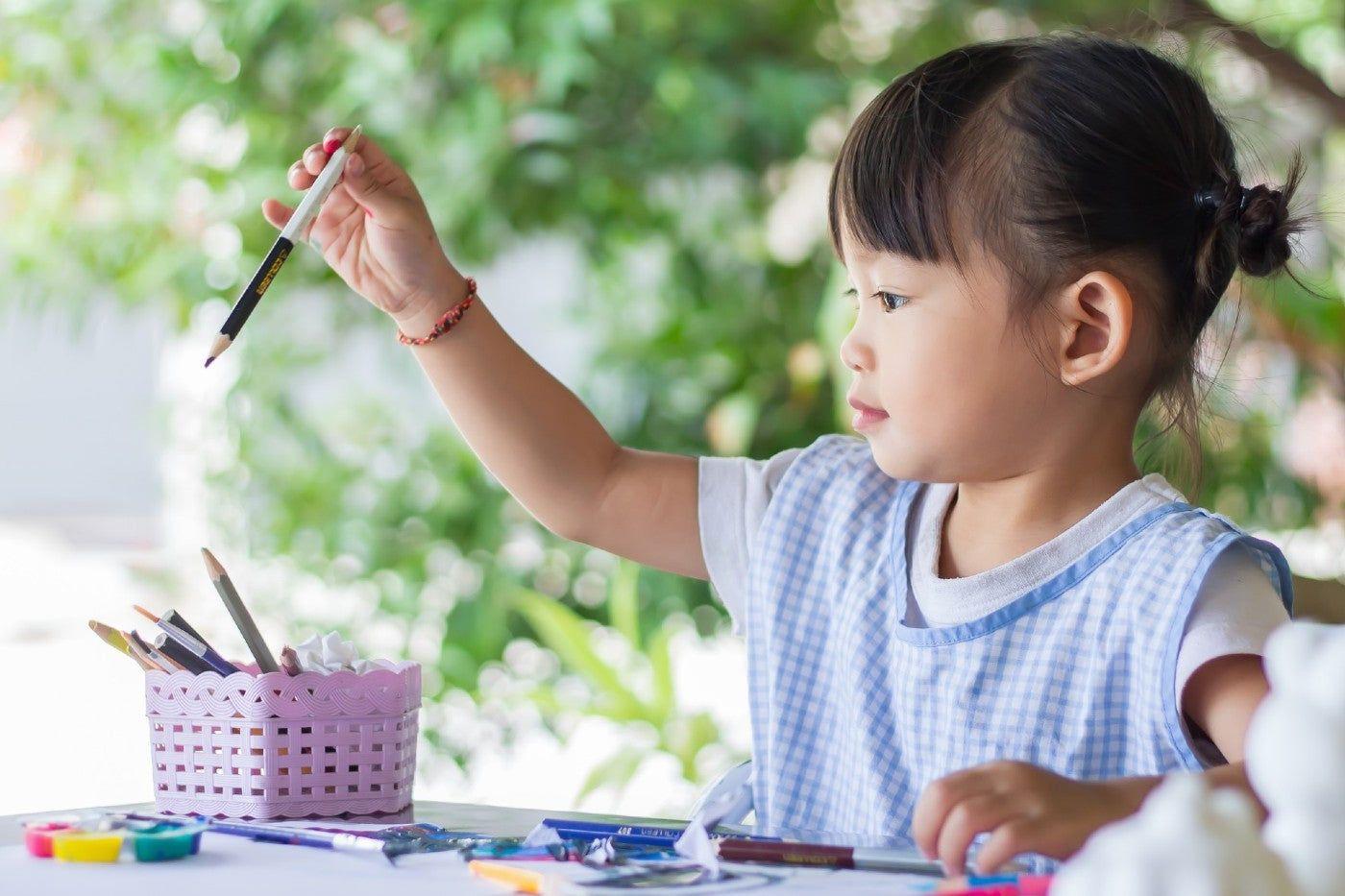
Between the ages of about 15 months and 2.5 years old, your toddler’s fine motor skills (the ability to make small movements with hands and wrists) are truly burgeoning as they start to embrace scribbling. To make grasping easier, dole out easy-to-grip, triangular crayons, thick and stubby pencils, and chucky washable markers.
But know that your toddler will not hold their crayon like you. Instead, they use either a fisted grasp or a palmar grasp, which is a fisted grasp with your kiddo’s thumb wrapped at the top of the crayon. This is totally normal! Kids will shift to a more grown-up grip soon enough. As far your child’s artwork goes, you will likely see lots of lines, loops, and spirals. And as your child inches closer to age 2, shapes that look like Ts and Vs appear as well.
At this age, the sensory intake of it all—the way the fat crayon feels in their palm, the squish and smell of the finger paint—is either what your kiddo loves...or loathes. If being at the art table puts your little one in sensory overload, do not push it. Simply dial the art back and gradually re-introduce creativity bit by bit. Another exciting development: By your kiddo’s second birthday, they may start to show a preference toward right- or left-handedness...but many toddlers do not demonstrate a tendency for several years.
Around age 3, your precious buddy’s muscle control is on the upswing, allowing for more precise finger and hand movements. That means the standard fist or palmar hold is starting to morph into an adult-like grasp, where your child’s thumb sits on one side of the crayon, and their fingers on the other. (This is called a tripod grasp.) It is still kind of clumsy and awkward, but it offers your child’s small hand enough control to make broad vertical and circular strokes. You will spy lots of repeat shapes and/or lines on the page, like oodles of open circles; diagonal, curved, horizontal, and vertical lines; and dots. (Shapes that look like Hs, Ts, Vs, and Xs start to appear on drawings, too.)
Your little one’s concentration—and their desire to discover—is developing rapidly, leading to a new hankering for tracing simple shapes, using (child-safe) scissors, clay play, and finger painting. No grand artistic planning is happening quite yet though. Your child likely will not be able to sit down and decide to draw a kitty cat, for instance. Instead, they will take a gander at their collection of scribbles and circles and then proudly declare that they made a cat.
Between the ages of 4 and 5, your kiddo begins to really think through their creations before they pick up their crayon. And because their grip control is way improved (and looking more like yours), you will start to notice a difference in what your child is producing, too. Colouring in the lines is likely now a thing. Plus, more details and more colour will creep into your child’s creations.
Your kiddo can now draw and trace more complicated shapes and geometric patterns; they likely can aptly use a paint brush and cut and paste with relative ease. Circles are popular right now, too, as is combining shapes to make objects. (For instance, a triangle and a circle make a party hat.) And people!
Now, your child’s drawings of people will have eyes, a nose, and a mouth! Sure, the body might not totally be there, and the legs may or may not be protruding from the head...but they will 100% represent actual people. Chances are your child’s family portrait will also feature a shining sun in the corner, with lots of sharp rays pricking the edges of the irregular circle. But for the most part, people and objects will appear to float around the page.
Artistic growth for-sure does not stop now! Instead as your sweet baby grows into a school-age kiddo, they will have their own special style of drawing—and most of the work they churn out is totally recognisable. Some things to expect between now and 8-years-old, include:
From their early scribbles to their masterful self-portraits, show your child that you appreciate their hard work and creativity! Comment on their artistic process more than the final product. So instead of 'Is that a house? I love it!' try: 'Your picture is so interesting! I love all of the blues!' or 'Tell me about your picture.' And display their art on the fridge, on a special kids’ only gallery wall, or amongst the art and photos that pepper your living room walls. That way your child feels pride…and encourages to keep on creating!
For more ideas on how to get your (and your toddler's) creative juices flowing, check out these 20 toddler art project ideas.
Disclaimer: The information on our site is NOT medical advice for any specific person or condition. It is only meant as general information. If you have any medical questions and concerns about your child or yourself, please contact your health provider. Breastmilk is the best source of nutrition for babies. It is important that, in preparation for and during breastfeeding, mothers eat a healthy, balanced diet. Combined breast- and bottle-feeding in the first weeks of life may reduce the supply of a mother's breastmilk and reversing the decision not to breastfeed is difficult. If you do decide to use infant formula, you should follow instructions carefully.