TODDLER
11 Science-Backed Ways to Boost Language Development
Surprise! Your little one is not a sponge who will magically learn All The Words. Instead, you need to help boost their language skills. Here is how.
Skriven av
Happiest Baby Staff
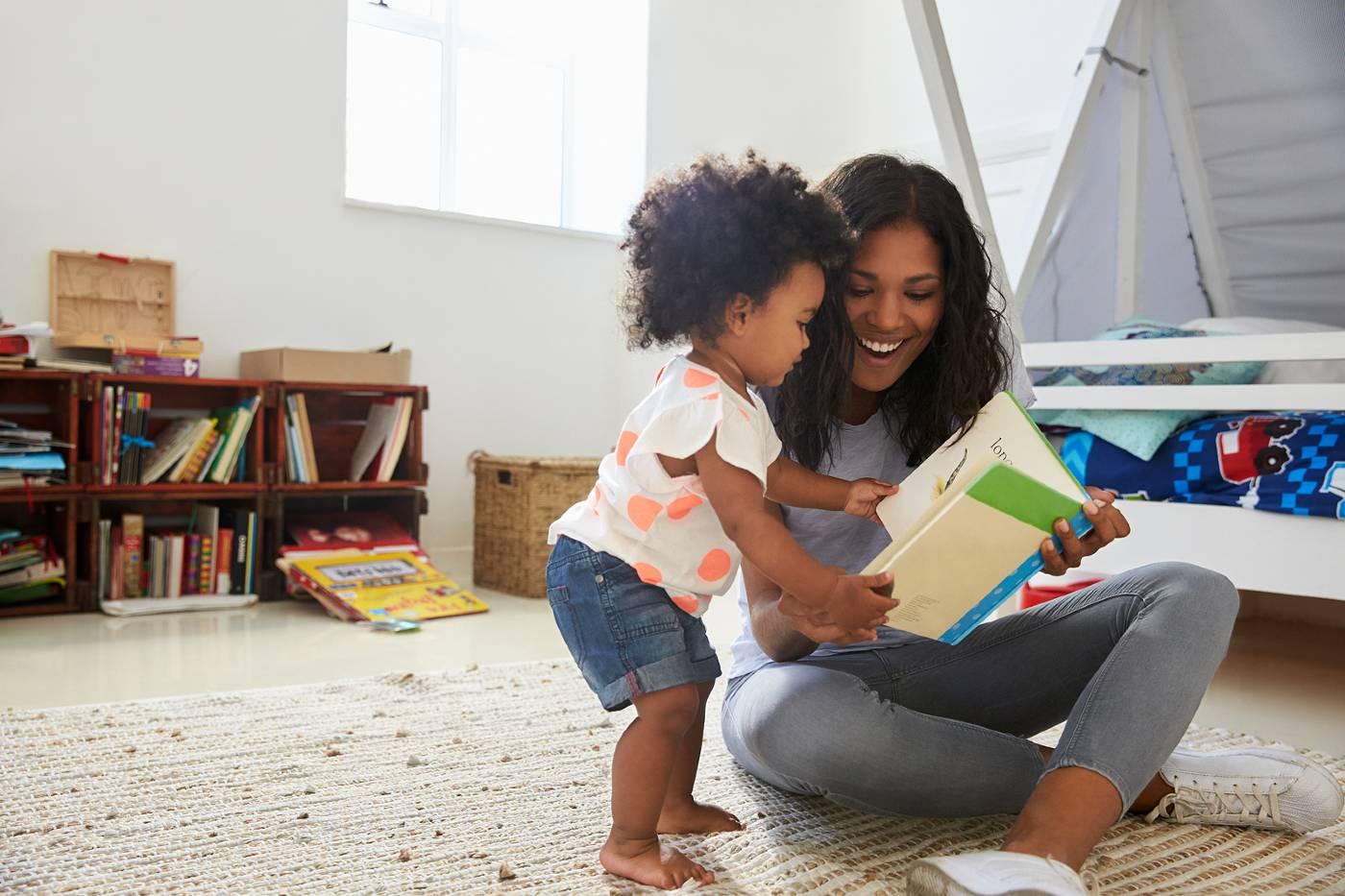
While it may take about a year (or more) to hear your little one’s first words, know that they have been honing their communication skills from the get-go. From the moment your baby is born, they are absorbing all the sounds, tones, and words around them, manipulating them in their growing brains to finally communicate with you. But do not be fooled! Your precious child is not a passive sponge, waiting to absorb All The Words. Instead, your small one needs your help to boost their language, comprehension, and speaking skills. Here, 11 scientifically proven ways to do just that.
Go all-in with babytalk.
The more you use so-called babytalk when communicating with your infant, the quicker they grasp language, notes a report in the journal Cognitive Science. Researchers found that favouring words that end in 'Y' (tummy, kitty, doggy, bunny, daddy) and those that repeat sounds (choo-choo, night-night) are the most effective. Earlier reports also found that exaggerating vowel sounds and raising your pitch are super-effective babytalk strategies. It is no wonder, since experts say that babies’ brains show increased neural activity when they hear sing-songy babytalk versus boring old grown-up speak.
Have baby conversations.
Starting at about 4 months old, your baby will begin to babble. (Squee!) But your baby is not being cute, just for the sake of being cute. They are communicating with you...so talk back! After all, responding to your baby’s babbles with words and sentences leads to larger vocabularies down the road, according to research in the journal PLOS One. Keep the back-and-forth going as your toddler grows. Conversations between little ones and their parents actually change a child’s brain, aiding language development, including vocabulary, grammar, and verbal reasoning, found Harvard researchers.
'Read' picture books.
Parents do not need to read words off the page of a book to impart language know-how to their kiddos. No matter if you share a book with a story or a book with just pictures, your child will reap the language-building rewards, according to a study in the journal Frontiers in Psychology. Researchers found that toddlers are privy to just as much sophisticated language and info when parents read picture books as when they read 'educational' books. The reason? Parents tend to ask questions (Where do you think the squirrel is going?) and make related observations (We saw a squirrel this morning in our backyard!) when sharing picture books.
Read storybooks, too!
Reading Goodnight Moon to a small infant may seem pointless, but rest assured, it is not! Sharing books with your child beginning in early infancy increases vocabulary (and reading skills) four years later, according to researchers at NYU School of Medicine. But do not stop there! Just one year of daily at-home read-alouds for a 4-year-old exposes them to 75,000 more words than if they were not read to at all. (All those words bulk up a vocabulary and aid early literacy development.) Moreover, kids who live in literacy-rich homes (averaging about 5 books a day) start kindergarten having heard about 1.4 million more words than tykes who were never read to. To get even more out of your story time, try these activities.
Put books on repeat.
So you have got a giant bookshelf brimming with tons of wonderful stories, but your nugget is always picking the same darn book over and over again. (Gah!) But before you beg for a trade, know this: Research in the journal Frontiers in Psychology found that children learn more new words if a story is read to them multiple times than if several stories are read to them only once. So, yes, vary up your bedtime story go-tos…but only after you read Dragons Love Tacos three times in a row!
Name everything!
You know the drill: You are strolling down the sidewalk with your little one and you spy a dog. Doggy! A little further down the road, zooms a fire truck. Fire truck! Later, you pop into the ice cream shop and hand over a cup brimming with mint chocolate chip. Ice cream! That instinct to call out the name to anything and everything you see is spot on. Research shows that when a grown-up labels various objects that they see with their child, their child is quite simply more likely to learn the word for that object.
Play pretend.
Getting down on the ground and playing with your tyke is always a good thing. And if you and your baby engage in what is called symbolic play, well, that is even better! Symbolic play is when you, say, pretend a banana is a phone, a block is a car, or a cardboard box is a rocket ship. Research has shown that when parents engaged in this type of make-pretend play with their 18- to 24-month-olds, they were more likely to ask questions, which led to way more conversations between the pairs, which (natch), lead to more language growth.
Embrace two languages.
If you know more than one language, go ahead and speak them all! Not only will you not confuse your budding linguist, but you will also actually improve your young one’s communication skills. Research in the journal Psychological Science has found that children growing up in multilingual homes are better at accurately deciphering what people are trying to say than children who are exposed to only one language. The kicker? Your child does not have to be bilingual to garner the benefit! It is simply the exposure to more than one language that builds more effective communication skills.
Wiggle in new words.
Exercise, it seems, can help to improve a child’s vocabulary, according to a report in the Journal of Speech Language and Hearing Research. Here, researchers found that kids aged 6 to 12 who swam after being taught several new words were 13% more accurate in follow up vocabulary tests than kids who coloured. It is thought that moving your body increases levels of brain-derived neurotrophic factor (BDFN) which, essentially, is brain fertiliser, helping littles encode new words. To get the most out of post-learning active-time, choose an exercise that your child can do automatically, without much thought or instruction.
Start counting.
Learning your 1-2-3s can lead to knowing your A-B-Cs! Three- to 5-year-olds who engage in math activities at home improve their math skills (of course!), and their vocabulary, according to research out of Purdue University. No baby algebra required. Instead, it is all about incorporating math concepts into the everyday, like saying 'here are three apple slices,' counting the stairs as you climb, or asking how many dolls are on the bed. Investigators believe that math-talk spurs dialog between kids and parents that improve oral language skills.
Embrace some quiet.
For some, the low hum of the telly forever in the background is like grown-up white noise...but for toddlers, this type of sound is detrimental to language development, according to a study in the Journal of Children and Media. Researchers found that when the telly was on in the background, parents spoke less than when the telly was off. This matters because parents talking is intrinsically linked with child language development.
Stumped how to keep toddler conversations going? Check out these excellent get-talking tips for ages 12 months to 5 years!
Ansvarsfriskrivning: Informationen på vår webbplats är INTE medicinsk rådgivning för någon specifik person eller tillstånd. Den är endast avsedd som allmän information. Om du har några medicinska frågor och funderingar om ditt barn eller dig själv, vänligen kontakta din vårdgivare. Bröstmjölk är den bästa källan till näring för spädbarn. Det är viktigt att mödrar äter en hälsosam, balanserad kost i förberedelse för och under amning. Kombinerad amning och flaskmatning under de första veckorna i livet kan minska tillgången på en mammas bröstmjölk och det kan vara svårt att ångra beslutet att inte amma. Om du bestämmer dig för att använda modersmjölksersättning bör du noggrant följa instruktionerna.






DELA DENNA ARTIKEL
FÖRÄLDRARS VAL
Bästsäljare