BABY
When Do Babies Walk?
While that very first step gets a lot of the glory, your baby spends an impressive amount of time building up to that wobbly walk.

Skriven av
Dr. Harvey Karp
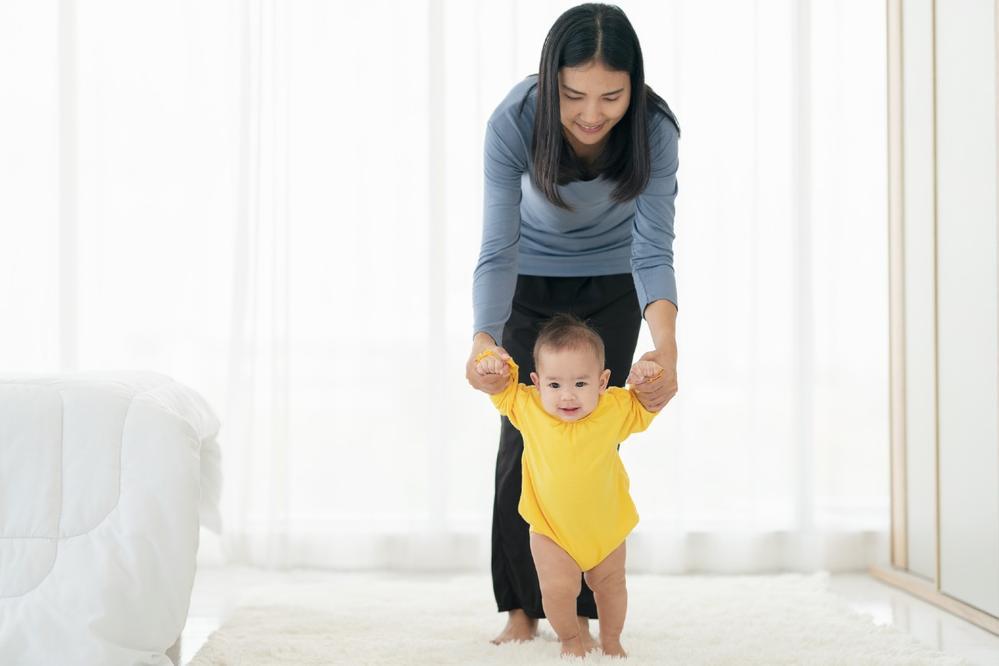
Watching your baby take their first steps is an undeniably special milestone—that may very well come with some mixed emotions when you realise how much your baby has grown. (And how you have already fallen behind if you have not baby-proofed the house, yet!) But, while that very first step gets a lot of the glory, your baby spends an impressive amount of time building up to that wobbly walk.
When do babies start walking?
When it comes to walking, there is a particularly wide average developmental range: Some babies are toddling around the room well before their first birthday while others are not ready to take that first baby step until closer to 18 months. Part or that timing is related to your child’s internal abilities, some of us have better balance than others. But it is also related to your tot’s inborn temperament: daredevil and thrill seeking or cautious and contemplative. For example, one baby might be content to cruise around the room for weeks while another is eager to get on with unassisted walking after just a few days of practice.
When should a baby walk without support?
Some babies walk as early as 8 months and others take until 18 months. Of course, most are in the middle and get pretty mobile between 10 and 15 months. Research shows that exactly when a baby takes those first steps has no correlation with their ultimate intelligence or coordination. Standing and walking are also much slower in babies who are uber flexible. So, if your child does the splits every time she tries to stand…her flexibility may be the cause. It will later be fantastic help in dance and gymnastics. And actually, late walking is a blessing….fewer accidents!
What are signs a baby is going to walk soon?
Unlike rolling over, which seems to start on a specific day…and never stop, there is lots of build-up before the first step—so you will probably see this milestone coming from, well, miles away. Generally, you will know that your baby is getting ready to walk when they can pull themselves up, cruise along—clinging to the sides of furniture for balance— and stand independently for five to 10 seconds. By the time they can stand, most babies will be walking within a few months.
How can I help my baby learn to walk?
To be honest, infants really do not need much help learning to walk. They are pretty unstoppable! It starts with rolling, sitting, and crawling. Along the way, they are building their strength, coordination, and balance skills—all of which are essential for those first steps. And, before you know it, your tiny baby has figured out how to balance that big, heavy head on that skinny little neck…almost a metre above the ground!
When you notice your baby is getting ready to walk, here is how to be the cheerleader: As they cruise along the furniture or pull to stand, sit on the floor about a foot away and hold out your hand. That is for your tot to grab and stabilise. Take your time…and be positive…but there is no need to applaud too hard.
To boost your baby’s balance and coordination, work on walking while holding their hand or by letting them use a little bouncy seat or push toy (like a toddler-sized shopping cart) while you supervise. Notably, experts discourage using baby walkers, which have been shown to cause injuries and delay motor development.
Walking is a big physical feat, but it is also a mental challenge—so helping your baby develop their confidence is important! And that means not making them feel there is huge pressure form you for them to succeed. You want your child’s sense of success to come from their inner joy, not from making you happy!
Ansvarsfriskrivning: Informationen på vår webbplats är INTE medicinsk rådgivning för någon specifik person eller tillstånd. Den är endast avsedd som allmän information. Om du har några medicinska frågor och funderingar om ditt barn eller dig själv, vänligen kontakta din vårdgivare. Bröstmjölk är den bästa källan till näring för spädbarn. Det är viktigt att mödrar äter en hälsosam, balanserad kost i förberedelse för och under amning. Kombinerad amning och flaskmatning under de första veckorna i livet kan minska tillgången på en mammas bröstmjölk och det kan vara svårt att ångra beslutet att inte amma. Om du bestämmer dig för att använda modersmjölksersättning bör du noggrant följa instruktionerna.






DELA DENNA ARTIKEL
FÖRÄLDRARS VAL
Bästsäljare