TODDLER
7 Ways to Teach Kids Mindfulness
Surprise: Your toddler can start mindful meditation at age 2! Here’s why they should.

Scritto da
Happiest Baby Staff
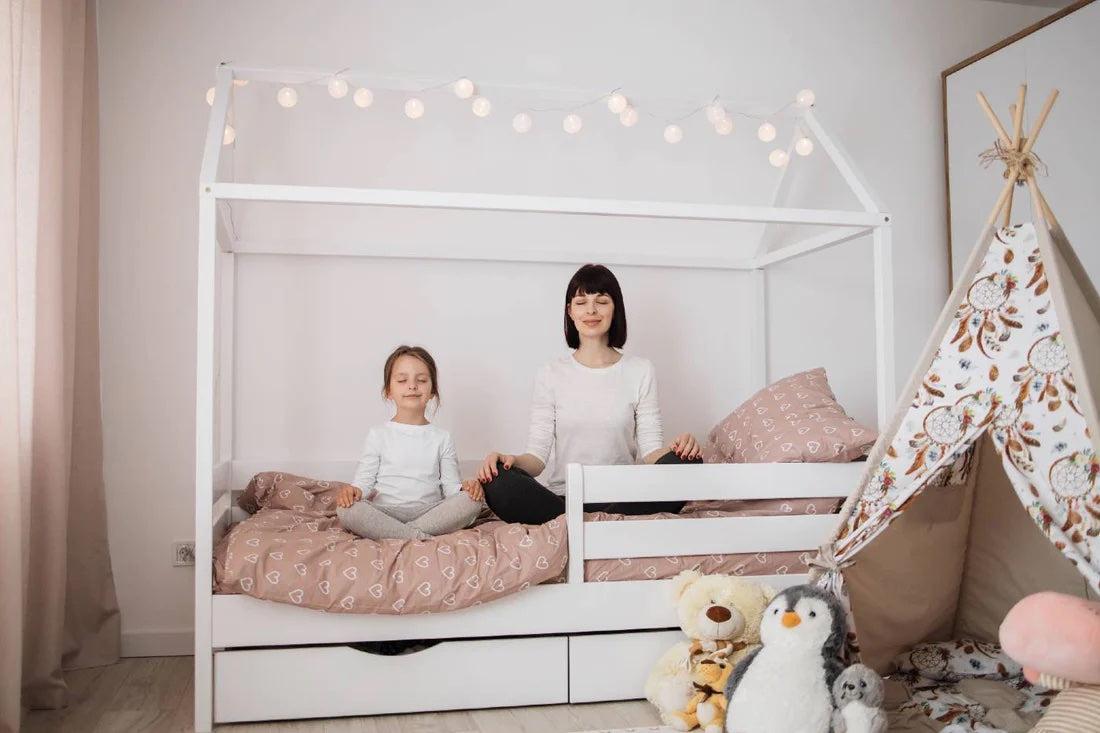
Long gone are the days when mindful meditation was considered hippy-dippy or some type of “alternative” practice. In fact, 43% of adults surveyed said they turned to meditation to help cope with pandemic stress. And 4.3 million children in the U.S. practice mediation, according to a 2019 report in the journal Complementary Therapies in Medicine. So why exactly are there mummy-and-me meditation classes? Why are we teaching nursery school children how to belly breathe? And why does the American Academy of Pediatrics (AAP) encourage parents to share meditation with their children? Keep reading to learn why children benefit from meditation and how you can teach mindfulness to your child today.
What is mindfulness?
In the simplest terms, mindfulness means paying full attention to something. Mindfulness is the opposite of multitasking, rushing, and looking at your phone while “listening” to your spouse, watching TV, or playing trains with your little one. When you—or your child—are being mindful, you’re taking time to calmly focus. And to achieve this serene state, it’s important to home in on your breathing. This helps you to stay in the present…instead of letting your thoughts wander to the past or becoming distracted by the chaos around you.
What are the benefits of mindfulness for children?
According to the AAP, teaching children how to be mindful “could be one of the greatest gifts you give them,” because mindfulness helps children relax and focus, so that they can “function more effectively and clearly.” Experts note that mindfulness can be especially helpful for kids who become easily upset or impulsive, including those with ADHD, depression, anxiety, or autism. Being mindful may help children—and their grownups...
- Pay better attention
- Sleep better
- Be less distracted
- Remain calm under stress
- Regulate emotions
- Improve patience
- Avoid rushing
- Lower blood pressure
How often should children practice mindfulness meditation?
There are no hard and fast rules when it comes to when—and how often—children meditate. But consider following these time frames from Dr. Harvey Karp and the AAP:
Toddlers over age 2: A few minutes a day- Nursery-schoolers: A few minutes a day
- School children: 3 to 10 minutes twice a day
- Teens and adults: 5 to 45 minutes a day or more
For little ones, Dr. Karp recommends practicing mindful meditation before a nap or after eating, when your tot’s already a bit relaxed.
How to Teach Mindfulness to Children
Anyone can practice mindfulness—even toddlers! Here are some creative ways to show your little one how to be more mindful.
Starfish Breathing
Have your tot hold out one hand with their fingers spread wide, like a starfish. Then, with their other hand, have your child use their finger to slowly trace up their thumb as they inhale. Then, ask them to exhale while tracing down toward the inside of the thumb. Encourage your tyke to continue breathing and tracing until they’re finished with their entire hand, er, starfish!
Mindful Storytime
Between reads of Goodnight Moon and Moo, Baa, La La La!, squeeze in some books that teach mindfulness, such as Look and Be Grateful by Tomie dePaola. This board book for children 0 to 3 celebrates gratitude and mindfulness with the help of a young boy who takes notice of the simple and profound beauty that surrounds him, from the rising sun to a teeny ladybug. Got a fan of The Very Hungry Caterpillar in your house? Then try Eric Carle’s Calm With The Very Hungry Caterpillar, a book that helps 3 to 5 year olds (and their parents) remember to pause, take a breath, and get in touch with their feelings. For a step-by-step guide for kids 4 to 8, try Meditate with Me by Mariam Gates, where cute animals teach children how to focus their breathing, settle their busy minds, and more.
Magic Breathing…With a Friend!
To make learning mindfulness more fun for the 2-and-up set, recruit SNOObie, the adorable white noise machine and nightlight that encourages mindful breathing with synchronised light and sound. This SNOObie feature was designed to teach little ones Dr. Harvey Karp’s powerful calm-down technique called Magic Breathing, which also helps tots quiet their minds and bodies—and feel more in control of their big feelings. To get you both started…
- Find a comfy space free from distractions.
- Relax your faces and bodies and turn on SNOObie.
- Use the Rainbow Light Slider to pick a light colour.
- Use the Soundtrack Selector to navigate to a Magic Breathing track. Beginners should start with Fast Magic Breathing.
- Inhale and exhale slowly along with SNOObie’s breathing track and pulsing light. Together, practice relaxing your faces and breathing out a bit slower than breathing in. Feel your bodies fill up with air as the light gets brighter and breathe out as it dims.
- Help your child visualise this even better by lifting your hand up with each inhale and letting it gently drop on each exhale—almost like you’re an orchestra conductor!
Focus on the Five Senses
A quick and easy way to help center yourself—and your kiddo—is by using your five senses. To do this, have your child sit comfortably either inside or outdoors, with their hands resting on their thighs or on a table. Ask your bud to simply notice their breath, then ask them to take their time and name five things they can see, four things they can feel (internally and externally), three things they can hear, two things they can smell, and one thing they can taste. (You can offer food here if you’d like.) Engage each sense for 30 to 60 seconds and when done, talk about your shared experience.
Scrunch and Release
While adults and older kids might engage in what’s called a body scan meditation where they systematically focus their attention on each part of the body from their toes to their head, noting any sensations as they go along. For little ones 2 years old and up, this practice can be tweaked to a graduated body scrunching activity. Have your child to lie down and take a few deep breaths. Then ask them to scrunch (aka: tense) their tummy muscles for the count of two and then relax them. Ask how that feels. Then, start the process of scrunching and relaxing the whole body, starting with your kiddo’s toes, then calves, then bum…working your way up. Hold each scrunch for the count of two. This practice helps children relax, it heightens body awareness, and shows how to release pent-up emotions.
Meditate on Glitter
When emotions run big and your child needs some time to find their calm, meditative breathing can be a giant help…but it can be hard to get there mid-tantrum. To help make this practice easy-peasy—even when a meltdown is brewing—try using a visual sensory experience, like having your child shake a glitter-filled mindfulness jar…then watch as the glitter slowly falls to the bottom. Here, the slow-moving glitter works as a “visual anchor” to help your upset kiddo focus their attention on something besides their hot feelings—and watching the glitter slowly move can also trigger calm breathing. Be sure to show your child how the jar works during a peaceful time so that they can get familiar with it before they need it. (You can buy one or DIY a glitter jar with your child.)
Teddy Bear Breathing
Here’s another excellent, kid-focused mindful meditation to practice at bedtime or naptime from the experts at Zero to Three: Have your little one select their favourite teddy bear or other stuffy and then lie down with their legs straight and their arms at their sides. Take a beat to enjoy the stillness before you place the stuffed bear on the soft part of your bub’s belly. Ask your kiddo to feel the bear’s weight…then instruct your child to “rock” the bear to sleep. To do this, your child needs to take a long, slow breath into their belly…which will make Mr. Bear rise. As the bear goes up, whisper “up.” Then ask your child to exhale even more slowly, feeling their belly—and their bear—go down. As the stuffy goes down, whisper “down.” Ask your tot to close their eyes and continue the slow breathing and whispering for several minutes allowing them to rest and relax.
***
REFERENCES
- Pew Research Center: Americans Oppose Religious Exemptions From Coronavirus-Related Restrictions
- Prevalence, patterns, and predictors of meditation use among U.S. children: Results from the National Health Interview Survey. Complementary Therapies in Medicine. April 2019
- American Academy of Pediatrics (AAP): Just Breathe: The Importance of Meditation Breaks for Kids
- Nemours Children’s Health, KidsHealth: Mindfulness
- Child Mind Institute: The Power of Mindfulness
- A school-based health and mindfulness curriculum improves children’s objectively measured sleep: a prospective observational cohort study. Journal of Clinical Sleep Medicine. September 2022
- Mindfulness in primary school children as a route to enhanced life satisfaction, positive outlook and effective emotion regulation. BMC Psychology. volume 8, July 2020
- Breathing awareness meditation and LifeSkills Training programs influence upon ambulatory blood pressure and sodium excretion among African American adolescents. Journal of Adolescent Health. January 2011
- Understood: The importance of mindfulness for kids who learn and think differently
- Ann and Robert H. Lurie Children’s Hospital of Chicago: 8 Mindfulness Activities & Exercises for Kids
- Kaiser Permanente: 10-minute body scan
- Zero to Three: Breathing with a Buddy
Avvertenza: Le informazioni presenti sul nostro sito NON sono consigli medici per alcuna persona specifica o condizione. Sono solo intese come informazioni generali. Se avete domande o preoccupazioni mediche riguardo vostro figlio o voi stessi, si prega di contattare il vostro fornitore di assistenza sanitaria. Il latte materno è la migliore fonte di nutrizione per i neonati. È importante che, in preparazione e durante l'allattamento al seno, le madri seguano una dieta sana ed equilibrata. L'allattamento misto (seno e biberon) nelle prime settimane di vita può ridurre la produzione di latte materno e la decisione di non allattare al seno può essere difficile da invertire. Se decidete di utilizzare il latte artificiale per neonati, dovreste seguire attentamente le istruzioni.
Principali notizie






CONDIVIDI QUESTO ARTICOLO
SCELTE DEI GENITORI
Bestseller