TODDLER
The Best Toys for Babies and Toddlers—According to a Paediatrician
Play is essential for children in so many ways—here are the types of toys to stock in your playroom.

Scritto da
Dr. Harvey Karp
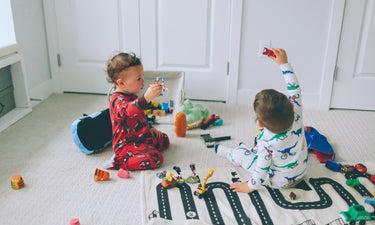
Play is essential for children in so many ways. Play, after all, is how young children engage and interact with the world around them! In short, play fosters a child’s cognitive, physical, social, and emotional well-being. Play allows for a child’s creativity, imagination, and even dexterity to flourish. It encourages healthy brain development. The list goes on!
While all play—and all toys—can be beneficial, there is a reason we encourage what they call 'true toys,' such as building blocks and dolls. Toys like these that are free of bells-and-whistles allow a child’s imagination to fully flourish...so do toys that are not toys at all, like pots and pans, wooden spoons, and cardboard boxes!
What are the best toys for toddlers?
While there has been much 'innovation' and change in the toys available today for toddlers and nursery schoolers, the truth is, traditional toys are still the most beneficial ones. In fact, core elements of many electronic toys, like flashing lights and sounds, can not only detract from social engagement, they also encourage passive play, which means they demand less creativity and imagination.
On the other hand, toys like dolls, action figures, cars, and pretend kitchens are gold-star toys for pretend play. Building blocks, simple puzzles, and choo-choos hone fine-motor development...so do art toys, like molding clay and colouring books. Meanwhile, card games like Go Fish and early board games bolster language skills. These do a great job of facilitating caregiver-child interactions, peer-to-peer play, and, of course, they all help to bolster a child’s imagination. High-quality toys are also open-ended, meaning children can play many different games with them.
Children are wonderfully imaginative creatures. Can a kid dive into a rich world of pretend play with, say, an action figure that barks commands if the button on his back is pushed? Of course. The thing is, if that same action figure was battery-free, your child would be the one leading the storyline of their play...not the toy. Remember: The more a toy does, the less your child must do! In the end, it is always preferred that you offer your child a toy or a household object that allows them the power to lead...and to work their imagination to its fullest.
Some of my very favourite toys for toddlers include:
- blocks
- nesting toys
- sand and water play toys
- puzzles
- shape-sorters
- crayons
- play dough
- dress-up clothes
- action figures
- stuffed animals
- dolls
- vehicles
- early board and card games
- dollhouses
- play versions of food, tools, keys, phone, brooms, and more
- musical instruments
- everyday items like cardboard boxes, pots, and pans, and wrapping paper tubes
How do toys help with development?
Overall, high-quality, open-ended toys are key pieces of early child development because they all-at-once can bolster cognitive and language development, problem-solving, logic-building, social skills, imagination, fine-motor and hand-eye coordination, and social-emotional skills. Of course, for a young toddler, these things do not just happen once you hand over, say, a doll or choo-choo. Instead, play with grownups is often needed to truly support these types of skill development with little ones. Playing with your young child sets the play foundation for future solitary and kid-to-kid play, where exploration and creativity continue to bloom.
Can toddlers have too many toys?
Yes! We know that being surrounded by too many toys all at once can overwhelm children and, interestingly enough, leads to more boredom and less fulfillment. It is also much harder for toddlers and nursery schoolers to concentrate on—and, in turn—enjoy any specific toy when there are so many. Keep in mind, children do not need, say, a specific barn designed to house their toy animals. Children are naturally wonderful at reinventing objects and toys. So, a shoebox or building blocks can easily become the animal shelter they are looking for.
With that, a good way to avoid too many toys is to stock your playroom with mostly toys that can grow with your child over the span of different developmental stages. For example, a young toddler stacks blocks, while an older child uses them to construct grand cities for their cars to ride through. Also, create a regular toy rotation with what you already have. That means, only keep a third to a half of your child’s toy available at any given time...and store the rest. Then, biweekly, seasonally, or whenever you would like, rotate what is out and what is in storage. This strategy keeps a child’s toy collection feeling new and exciting—and leaves children feeling less overwhelmed and more likely to explore their imagination at playtime.
Avvertenza: Le informazioni presenti sul nostro sito NON sono consigli medici per alcuna persona specifica o condizione. Sono solo intese come informazioni generali. Se avete domande o preoccupazioni mediche riguardo vostro figlio o voi stessi, si prega di contattare il vostro fornitore di assistenza sanitaria. Il latte materno è la migliore fonte di nutrizione per i neonati. È importante che, in preparazione e durante l'allattamento al seno, le madri seguano una dieta sana ed equilibrata. L'allattamento misto (seno e biberon) nelle prime settimane di vita può ridurre la produzione di latte materno e la decisione di non allattare al seno può essere difficile da invertire. Se decidete di utilizzare il latte artificiale per neonati, dovreste seguire attentamente le istruzioni.
Principali notizie






CONDIVIDI QUESTO ARTICOLO
SCELTE DEI GENITORI
Bestseller