PARENTS
9 Ways to Fall Asleep Faster
Racing and resting do not really seem to go together—except when it comes to a busy parent’s quest to fall asleep fast! Want a head start? Here, expert tips for getting to dreamland lickity-split.

Scritto da
Happiest Baby Staff
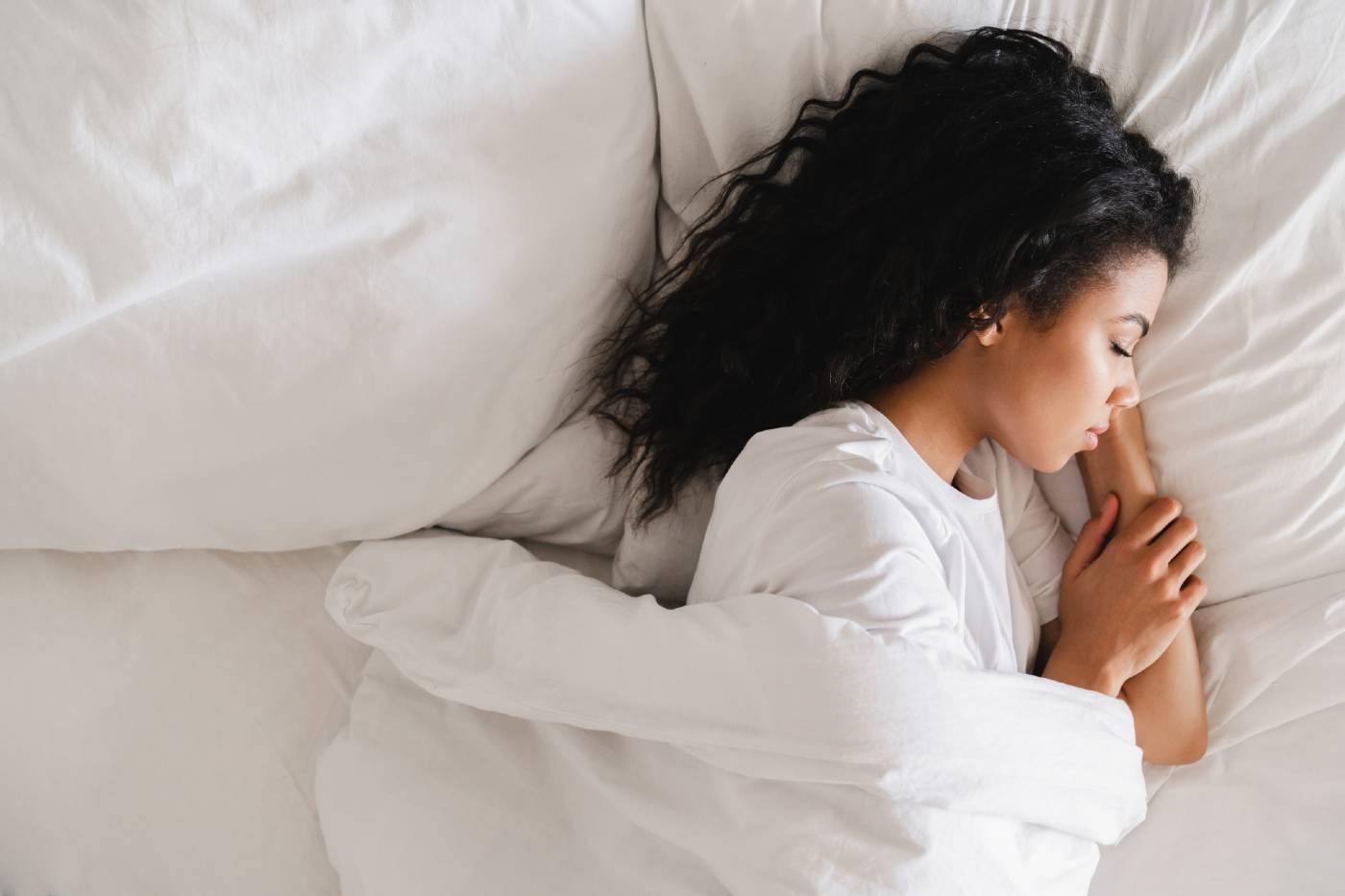
While racing and resting do not really seem to go together, the truth is, many of us are looking for the fastest way to fall asleep. If you are one of those folks, you are in luck. We have got some scientifically proven ways to fall asleep faster right here.
How long should it take to fall asleep?
If you are sharing a bed with someone who drifts off as soon as their head hits the pillow, do not be jealous. Going from goodnight to snoring in minutes could be a sign that your partner is seriously sleep deprived. Most people actually need up to 20 minutes to fall asleep—and others can take a bit more time. If you find yourself staring at the ceiling longer, here are some ways to jet to dreamland a bit faster.
Tweak the temperature.
It may come as a surprise to you, but your baby’s ideal sleeping temperature is not the same as yours! While little ones snooze best with the room temperature hovering between 20 to 22 degrees Celsius, drowsy adults thrive when their bedroom is roughly 18 degrees Celsius, though anything between 15 to 19 degrees could be your personal sweet spot for sleep.
When it comes to temperature tweaking, do not stop at the thermostat. You can further create the ideal climate for sleep by taking a warm 10-minute bath or shower an hour or two before you hit the hay. A 2019 study in the journal Sleep Medicine Reviews found that doing just that improved self-rated sleep quality, sleep efficiency, and sleep onset. Experts note that the process of cooling down from a warm shower signals to the brain that sleepytime is near.
Keep a predictable sleep schedule.
We are more like our little ones than we think! Babies need a sleep schedule to ensure they get enough rest and keep meltdowns at bay. And grownups need a sleep schedule for the same reasons! Plus, keeping a regular sleep schedule ensures that your trusty internal body clock stays 'on time,' which can help you fall asleep—and wake up—more easily. (By the way, your body clock does not take a break on the weekends, so neither should your sleep schedule.)
However, the sleep schedule that works for you may not be the sleep schedule that works for someone else. In other words, do not force yourself to go to bed at 9pm if you are naturally more of a night owl. The most important facets of a good sleep schedule are two things: consistency and a sufficient sleep span. To figure out your best bedtime, look at when you need to get up in the morning (or let’s be honest, when your little ones pop out of bed) and then subtract about seven or eight hours from that time. (The NHS recommends that adults clock at between seven and nine hours of sleep a night.)
Quit screens earlier.
According to Royal College of Paediatrics and Child Health, screens should be avoided for an hour before the planned bedtime. Folks who are frequent bedtime screen users report having trouble falling asleep about three days a week. The reason? These devices emit blue light that has been shown to reduce or delay our evening production of melatonin, a sleep hormone. That means that pre-bedtime screens decrease sleepiness, delay sleep onset, and shrink both REM and slow wave sleep, which are vital for cognitive functioning, according to research. If that is not enough, doing or watching anything that activates the brain (like watching telly) before bed is going to keep us wide-eyed longer. The solution? Remove all screens from your bedroom, including the telly, and stop watching and scrolling about an hour or two before going to bed. If that is too big of an ask, start by putting your devices on Nighttime Mode. This will reduce brightness and your blue light exposure. Still, aim to give yourself at least 30 to 45 minutes of screen-free time to relax, unwind, and prepare for sleep.
Dim your lights.
While you are nixing light from screens, remember that other artificial light can disrupt melatonin production, too. On the flip side, research shows that darkness boosts the production of this essential sleep hormone. So, if you have trouble nodding off, experts advise that you dim the lights a full two hours before you want to go to sleep. At the same time, installing blackout curtains can help you fall asleep faster, too. Again, evening light exposure can disrupt your body clock, aka your circadian rhythms, making it more difficult to fall asleep.
Turn on the white noise.
Another case of, 'Babies: They are just like us!' White noise is a fantastic sleep aid for newborns, babies, toddlers, and even grownups. While white noise no longer activates our long-dormant calming reflex, it does tap our sleep muscle memory, helping us get to sleep easier—and stay asleep. (Do you succumb to a case of the yawns when in the passenger seat? Does the steady hum of the highway make your eyelids droop? That is your sleepytime muscle memory!)
White noise does double sleepytime duty by also muffling sounds—like a neighbour’s party—that could easily delay your sleep onset and wake you up. The best white noise for sleep is low-pitch, droning, and hypnotic—not inconsistent, like music, ocean waves, or chirping birdies. Consider playing white noise as part of your wind-down routine and all-night long. (Psst: Our white noise SNOObear works for babies, kids…and you!)
Get outside in the morning.
You know how exposure to unnatural light in the evening mucks up your body clock? Well, exposure to natural light during the day does the opposite: It helps keep that internal clock running as it should! Subjecting your body to bright light in the morning sends a 'stay alert' signal to your brain—and, it helps you fall asleep earlier in the evening. Win, win! Bonus: Research shows that a regular one-hour walk in the natural morning daylight is as effective as bright light therapy for seasonal mood disorders. (The antidepressant-like effect of light is most pronounced in the early morning hours.) Double bonus: a study shows that folks who report a bright environment in the mornings are more likely than others to say they are in excellent or very good health.
Move your body.
Moderate-to-vigorous exercise has been shown to reduce sleep onset, which means it helps folks fall asleep faster, decreasing time spent staring at the ceiling, wishing you were asleep. The positive sleep effects start to kick with as little as 30 minutes of moderate aerobic activity for five days a week. This is partly because exercise decreases levels of the stress hormone cortisol in our bodies. And, if you take your daytime workout outside, you are benefiting from the melatonin-affirming natural light exposure, which helps sleep onset, too. Not an early riser? No worries. Getting regular exercise any time of the day can help you fall asleep faster! Just make sure to skip your strenuous workout within an hour or so of bedtime. (Vigorous or strenuous exercise is often defined as a workout in which you are unable to hold a conversation.)
Put your to-dos to paper.
What is it about bedtime that makes you want to make a mental checklist of all the tasks you need to do tomorrow? While there is no magic overthinking eraser you can utilise before bed, there are proven strategies to help put your stress to bed before you seek ZZZs. For example, according to a 2018 study, folks who took five minutes to write down their next-day to-do list before bed fell asleep an average of nine minutes faster than others. What is more, people who wrote very specific lists fell asleep even faster than those who wrote shorter, more general ones. (Use old-fashioned pen and paper, since typing your list into your blue-light emitting phone has the opposite effect on sleep onset.)
Try this in-bed activity.
You may already know that achieving an orgasm before lights-out is associated with falling asleep faster, but so is another in-bed activity, called progressive muscle relaxation (PMR). Here, you stretch out comfortably on your back and tense each muscle group in your body for four to 10 seconds on your inhale…then quickly relax the muscles on your exhale. (Give yourself up to 20 seconds to relax before moving on to the next set of muscles.) When done before night sleep, PMR consistently improves self-reported rates of relaxation, reduces pre-sleep anxiety, and helps people fall asleep faster, notes a report in the Journal of Clinical Nursing. PMR best practices include the following:
- Start by clenching your hands.
- Extend and bend your hands back at the wrist.
- Clench your hands into fists.
- Bend your arms at the elbows.
- Flex your biceps.
- Shrug your shoulders.
- Wrinkle you forehead into a deep frown.
- Close your eyes as tightly as possible.
- Smile as widely as you can.
- Press your lips together tightly, checking face for tension.
- Press your head back hard.
- Touch your chin to your chest, checking neck and head for tension.
- Take a deep breath and hold it, then exhale.
- Arch your back up and away from the bed.
- Suck your tummy into a tight knot, checking your chest and stomach for tension.
- Squeeze you bum tightly.
- Clench your thighs hard.
- Point your toes toward your face—then point them away and curl them downward at the same time.
- When you are done, count backward from 5 to 1.
Looking for more sleep help? Check out…
- Dr. Harvey Karp’s Guide to Surviving Daylight Saving With Kids
- Can New-Parent Sleep Loss Really Age You?
- Feng Shui Tips for Better Sleep
***
REFERENCES
- Cleveland Clinic: If You Fall Asleep Instantly—Is That a Good Thing?
- Sleep Foundation: The Best Temperature for Sleep
- Sleep Health Facts: Sleep Needs Across The Lifespan
- Too much time on screens? Screen time effects and guidelines for children and young people
- Before-bedtime passive body heating by warm shower or bath to improve sleep: A systematic review and meta-analysis, Sleep Medicine Reviews, August 2019
- Division of Sleep Medicine at Harvard Medical School, Get Sleep: Adopt Good Sleep Habits
- Harvard Health Publishing: Blue light has a dark side
- Blocking nocturnal blue light for insomnia: A randomized controlled trial, Journal of Psychiatric Research, 2018
- Does the iPad Night Shift mode reduce melatonin suppression?, Lighting Research & Technology, 2019
- Behavioral Strategies, Including Exercise, for Addressing Insomnia, ACSM's Health & Fitness Journal, 2018
- Evidence for the efficacy of melatonin in the treatment of primary adult sleep disorders, Sleep Medicine Reviews, July 2016
- CDC: Effects of Light on Circadian Rhythms
- Noise as a sleep aid: A systematic review, Sleep Medicine Reviews, February 2021
- Effects of light on human circadian rhythms, sleep and mood, Somnologie, August 2019
- Sleep Foundation, Exercise and Sleep
- Increased physical activity improves sleep and mood outcomes in inactive people with insomnia: a randomized controlled trial, Journal of Sleep Research, October 2015
- Exercise and sleep in aging: emphasis on serotonin, Pathologie Biologie, October 2014
- Effects of Evening Exercise on Sleep in Healthy Participants: A Systematic Review and Meta-Analysis, Sports Medicine, October 2018
- The effects of bedtime writing on difficulty falling asleep: A polysomnographic study comparing to-do lists and completed activity lists, Journal of Experimental Psychology: General, 2018
- Sex and Sleep: Perceptions of Sex as a Sleep Promoting Behavior in the General Adult Population, Frontiers in Public Health, March 2019
- Kaiser Permanente: Progressive Muscle Relaxation
- Self-relaxation training can improve sleep quality and cognitive functions in the older: a one-year randomised controlled trial, Journal of Clinical Nursing, May 2013
Avvertenza: Le informazioni presenti sul nostro sito NON sono consigli medici per alcuna persona specifica o condizione. Sono solo intese come informazioni generali. Se avete domande o preoccupazioni mediche riguardo vostro figlio o voi stessi, si prega di contattare il vostro fornitore di assistenza sanitaria. Il latte materno è la migliore fonte di nutrizione per i neonati. È importante che, in preparazione e durante l'allattamento al seno, le madri seguano una dieta sana ed equilibrata. L'allattamento misto (seno e biberon) nelle prime settimane di vita può ridurre la produzione di latte materno e la decisione di non allattare al seno può essere difficile da invertire. Se decidete di utilizzare il latte artificiale per neonati, dovreste seguire attentamente le istruzioni.
Principali notizie






CONDIVIDI QUESTO ARTICOLO
SCELTE DEI GENITORI
Bestseller