BABY
10 Household Objects to Keep Out of Baby's Reach
Keep a keen eye out for the following household objects to keep far away from curious hands.

Scritto da
Happiest Baby Staff
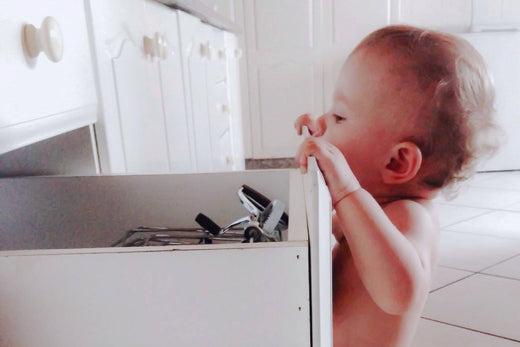
Between about 6 and 9 months your little one is likely on the move, creeping and crawling all over the place…and you will never look at your home the same way again. So many nooks baby can get into; so many wires to pull; so many sharp corners. Gah! But do not panic!
First, get some baby gates to keep your newly mobile toddler away from stairs. Next, get down on your hands and knees and explore your house to see what your child would see. You might be surprised by what you find! Keep a keen eye out for the following household objects to keep far away from curious hands.
Household Hazard No. 1: Plastic Bags
The plastic wrap that toilet paper is packaged in; the bags you bring your groceries home in; dry cleaning bags: All plastic bags are dangerous and can cause suffocation if your baby gets the bag over their heads. Keep bags safely tucked away where your child cannot reach them.
Household Hazard No. 2: Pet Toys and Food
Yes, it is super cute when babies and toddlers hang out with a beloved pet, but it is less cute—and potentially dangerous—if they get pet food or toys in their mouths and choke.
Household Hazard No. 3: Loose, Lost Objects
Lighters, coins, hairpins, tubes of lip balm, keys…anything that could have fallen out of a pocket or purse and landed on the floor could be dangerous to your baby. Do daily sweeps to make sure the floors are clear of tiny objects that your child could choke on.
Household Hazard No. 4: Remote Controls
Kids love playing with remote controls, but because the batteries in them pose a serious risk, they should be out of reach. Or, try using packing tape to cover the battery flap so that your baby cannot access the batteries.
Household Hazard No. 5: Phones, Chargers, Charging Ports
Keep all gadgets that get plugged into an electrical source or that could shatter and break away from young kids.
Household Hazard No. 6: Cleaning Chemicals
Are your dishwashing detergents, stain-removing sponges, or cleaning sprays, powders, gels, and liquids, under your sink…and easily accessible to kids? If so, get a babyproofing lock for the cabinet, ASAP—or store everything up high.
Household Hazard No. 7: Personal Hygiene Products
The same rule applies to personal care items such as makeup, soaps, bug sprays, sunscreens, hair styling products, and equipment such as curling irons, blow dryers, nail polish, and any other item that contains chemicals. All should be locked up.
Household Hazard No. 8: Basic Office Supplies
Pen caps, pencil erasers, staples, paperclips, and scissors: If your child can reach any small items on your desk, it is time to lock them away.
Household Hazard No. 9: Handbags
Do you toss your purse down when you walk through the door? If you do, stop! Your baby can easily reach inside and get their hands on items that can hurt them, like medications, keys, loose change, and breath mints.
Household Hazard No. 10: High-Risk Choking Items
Balloons, marbles, coins, watch batteries, and more are all very dangerous to babies and children. For a more complete list, review common choking hazards.
Babyproofing Refresher
To help keep the items above out of your baby’s reach—and to further safeguard them—it is time to get a handle of babyproofing. Here, a quick primer with a few baby proofing must-dos:
- Cover sharp corners. Use bumper guards to shield sharp corners on tables and other furniture.
- Check toy boxes. Heavy lids can not only hit your child in the head but trap them inside.
- Tether all furniture. It is especially important to secure bookcases and dressers that toddlers tend to climb on. Tethering will prevent tip-overs.
- Use baby gates. Place them at the top and bottom of stairs and in doorways where you do not want your child to go.
- Unplug small appliances. Toasters, blenders, coffee makers, hotplates: Anything that your baby could potentially reach, should be unplugged, with the cord safely stored.
- Move all houseplants. Plants, especially toxic ones, should go up high or into rooms where your baby cannot go.
- Install cabinet locks. Also consider hinge pinch guards, stove knob guards, and toilet locks to prevent accidents.
For more on child safety, check out:
What to Do If Your Child Swallowed a Foreign Object
Water Safety Rules for Kids and Parents
5 Ways to Protect Your Kids From Guns
Avvertenza: Le informazioni presenti sul nostro sito NON sono consigli medici per alcuna persona specifica o condizione. Sono solo intese come informazioni generali. Se avete domande o preoccupazioni mediche riguardo vostro figlio o voi stessi, si prega di contattare il vostro fornitore di assistenza sanitaria. Il latte materno è la migliore fonte di nutrizione per i neonati. È importante che, in preparazione e durante l'allattamento al seno, le madri seguano una dieta sana ed equilibrata. L'allattamento misto (seno e biberon) nelle prime settimane di vita può ridurre la produzione di latte materno e la decisione di non allattare al seno può essere difficile da invertire. Se decidete di utilizzare il latte artificiale per neonati, dovreste seguire attentamente le istruzioni.
Principali notizie






CONDIVIDI QUESTO ARTICOLO
SCELTE DEI GENITORI
Bestseller