BABY
Should I Try Baby-Led Weaning?
So your little one is ready to graduate to solids…but what do you feed your baby now?

Scritto da
Happiest Baby Staff
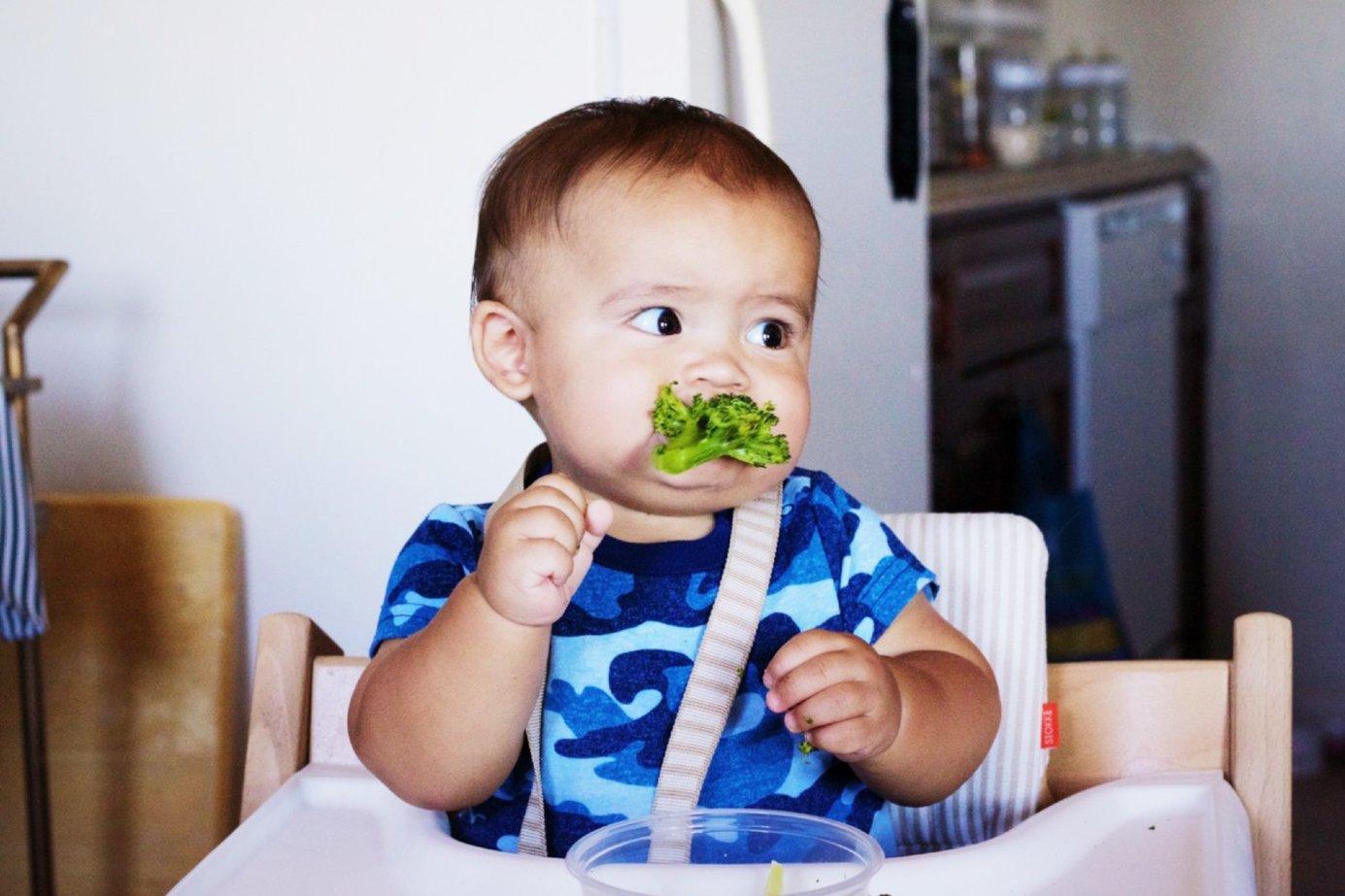
After months of a steady breastmilk and/or formula diet, there will come a time when your little one is ready to graduate to real food (hooray!). But with this big milestone comes the big question: What do you feed your baby now?
Though purees have long been a baby-food staple, since 2008 Baby-Led Weaning (or BLW for short) has exploded in popularity thanks largely to a book called Baby-Led Weaning by Gill Rapley and Tracey Murkett. The BLW approach gives babies a leading role in what they eat. Instead of you spoon-feeding pureed foods to your child, your child will eat soft, finger-sized pieces of whole food. Basically, you provide the gastronomic opportunities…then stand back while your baby explores what is on their plate.
When parents introduce babies to solid foods at around age 6 months, they give their children a non-pureed—but baby-friendly—version of whatever the grown-ups are eating. The key is that the food has to be big enough for the baby to grip it—and for it not to be a choking risk—and soft enough for them to bite it. From here, little ones can learn to pick up food with their hands and experience its smells, tastes, and textures.
The idea is that kids who learn to appreciate foods at the very beginning of learning to eat solids will eventually grow up to be good eaters with an appreciation for a wide variety of food types. There is some anecdotal evidence that kids who learn to eat solids through the BLW method will be less likely to become picky later.
What are the benefits of baby-led weaning?
Some possible benefits of baby-led weaning include:
- Bonding: Babies who eat at the table with their family will not only learn about foods and eating, but they will also learn table manners and spend quality time with their loved ones over food.
- Fine motor skills: In BLW, babies use their hands to eat. This means that they will have to work on hand-to-eye and hand-to-mouth coordination, as well as gripping and picking up with fingertips.
- Self-regulation: Babies who eat with their families and who feed themselves get a chance to recognise the feeling of being full. They have more control over how and when to stop eating, which is an important and often overlooked aspect of teaching kids to eat solids.
- Positive food habits: Babies who are given whole foods with a variety of colours, flavours, and textures, might have more open palates in the future.
When can you start baby-led weaning?
Babies are usually developmentally ready to start solid foods around 6 months of age. Typically, first foods include pureed veggies and fruits or infant cereals. But with baby-led weaning, babies tend to start eating single-ingredient whole foods (think: melon slices, avocado spears, or roast sweet potato wedges) and then move on to mixed foods (a version of whatever is on the family’s dinner table).
Signs that your baby is ready to eat solid foods include:
- Your baby can sit up unassisted.
- Your baby can hold their head up unaided.
- Your baby shows interest in eating.
- Your baby opens their mouth to eat.
What are the best foods for baby-led weaning?
With minimal preparation, just about any food can be given to a baby who is using the BLW method. That said, there are some safety tips to keep in mind.
- Babies have not yet mastered picking up small objects with their fingers. Make sure you cut food up into big enough piece that they can grab it with their whole hand.
- Do not offer choking hazards, such as grapes, hot dog pieces, nuts, popcorn, etc.
- Make sure that anything you serve your child is soft. Most vegetables can be steamed to soften them.
- Meats should be poached or boiled to a safe temperature and then shredded.
- Do not add salt, sugars, or artificial sweeteners to your child's food. They need to get to know natural flavours and textures.
Is baby-led weaning risky?
Parents’ biggest hesitation with BLW is that a baby will choke—which is understandable! However, babies come hard-wired to learn how to eat. It is typical and expected that babies may gag, make choking sounds, or cough from time to time when encountering new foods. The important thing is to stay calm and not show fear because your child will learn to become afraid of the natural gagging reflex.
The reality is that while kids will probably gag and spit up, they are not likely to choke. A study in the United Kingdom found that out of 155 babies fed by BLW or by spoon, parents reported that 93.5% never had a choking experience. Research also shows the risk of choking is the same for both babies fed BLW style and by spoon. That said, it is wise for all parents to take a CPR class to learn the signs of choking and the life-saving steps to intervene.
How to start baby led weaning:
Since food plays such a rich part in family culture, introducing your baby to solid foods can feel like a significant and exciting milestone for the whole family. Here are some tips to help your little one succeed:
- Patience: It is so important to be patient and understand that your baby will not love every dish you serve. Additionally, it helps to keep your reactions to how they eat as neutral as possible. Do not get upset if they refuse to eat—and equally, do not praise when they eat everything on their plate. Babies need to learn how to sense fullness and hunger as well as listen to their developing tastes.
- Variety: It is okay to let your baby play with their food. And they will definitely play! Give them baby spoons and forks, small bowls, and cups, and let them experiment. Give them variety with their food choices as well. Some kids will find softer purees to be a helpful bridge, while others will want smashed beans or veggies. Be patient and experiment.
- Make eating a family event: Get the whole family involved and have your baby take a seat at the table. Talk to them, share stories, and give them lots of opportunities to try different flavours and textures.
Fans of baby-led weaning tend to be very enthusiastic, but when it comes to feeding your family, do not feel like you have to take an all-or-nothing approach. You might find that a mix of purees and baby-led-weaning-style foods is best for your bub. There are plenty of ways to nourish your child and teach healthy eating habits outside of baby-led-weaning, too. The important part is that you are introducing lots of flavours and textures and nutrient-dense foods.
This article has been reviewed by Gabrielle McPherson, MS, RDN, LDN.
Avvertenza: Le informazioni presenti sul nostro sito NON sono consigli medici per alcuna persona specifica o condizione. Sono solo intese come informazioni generali. Se avete domande o preoccupazioni mediche riguardo vostro figlio o voi stessi, si prega di contattare il vostro fornitore di assistenza sanitaria. Il latte materno è la migliore fonte di nutrizione per i neonati. È importante che, in preparazione e durante l'allattamento al seno, le madri seguano una dieta sana ed equilibrata. L'allattamento misto (seno e biberon) nelle prime settimane di vita può ridurre la produzione di latte materno e la decisione di non allattare al seno può essere difficile da invertire. Se decidete di utilizzare il latte artificiale per neonati, dovreste seguire attentamente le istruzioni.
Principali notizie






CONDIVIDI QUESTO ARTICOLO
SCELTE DEI GENITORI
Bestseller