TODDLER
When Do Toddlers Learn to Share?
Sharing is caring…unless you are a toddler, then sharing is misery! Learn when you can really expect your tot to share—and how to encourage the behaviour.

Écrit par
Happiest Baby Staff
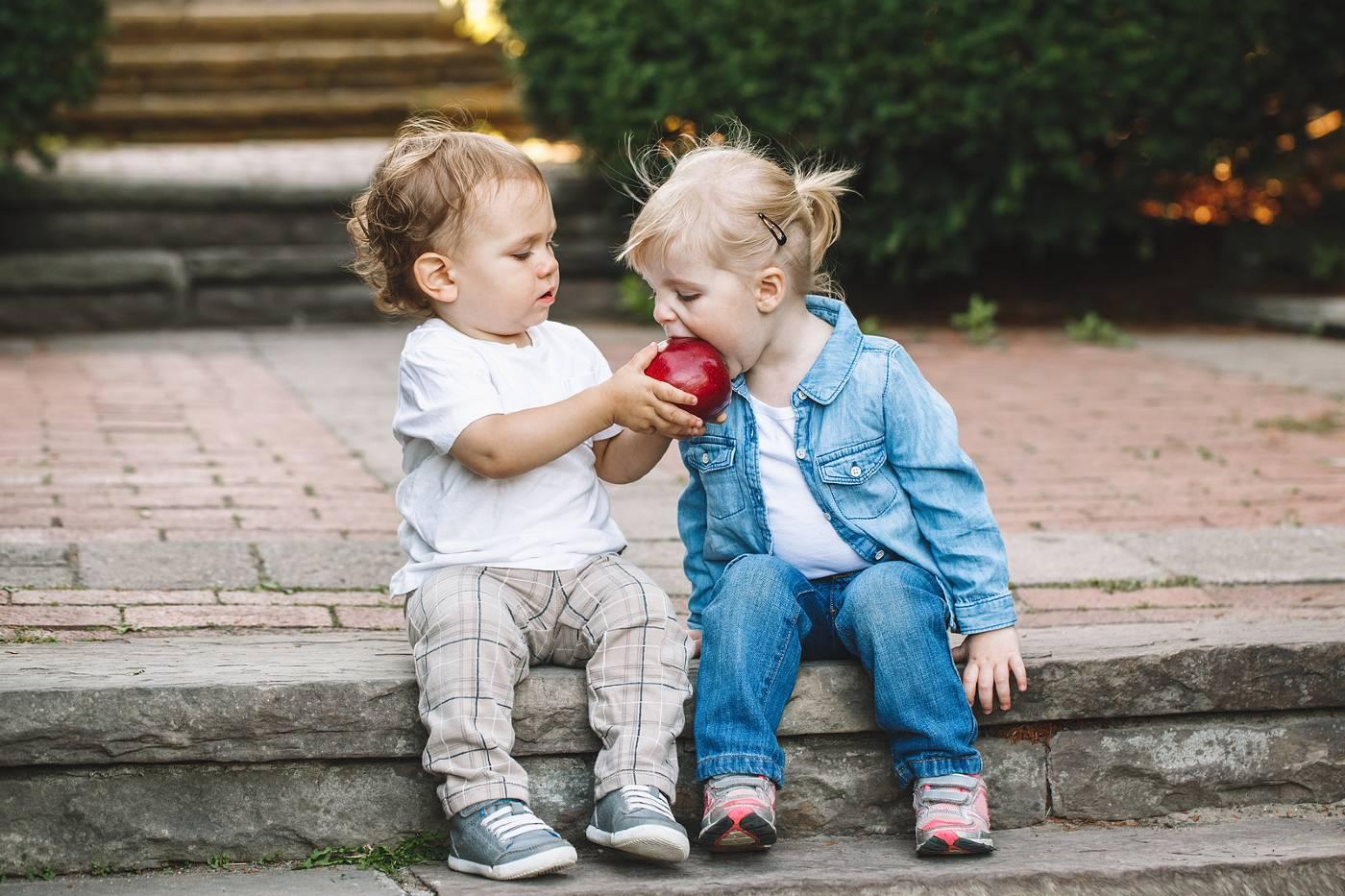
Parents desperately want to raise thoughtful, empathetic, good citizens of the world…which is why it can be so disheartening and, frankly, embarrassing, when your red-faced toddler bellows “MINE!” as they forcefully yank their choo-choo train out of a pal’s hands. Does your child’s refusal to share mean they are selfish? Heartless? Does it mean you have already failed as a parent? Or is your child simply too young to understand what it means to share? To find out—and to encourage age-appropriate turn-taking and sharing—keep reading!
At what age do kids start to share?
Children often learn to share between 3.5 to 4 years old, but this age range is wildly different than what many parents think! An American survey found that 43% of parents think children can share and take turns before age 2. And 71% believe toddlers have this ability before the age of 3. But the truth is, while sharing becomes easier to understand by 4 years old, oftentimes, the concept of sharing is not fully ingrained until 7 or 8 years old!
That is not to say your little one will not respond when you say something like, “Will you share your blocks with me.” They likely will! Researchers note that children are able to voluntarily share by the end of their second year, but it is infrequent unless you—a trusted grownup—explicitly ask them to share with you. That means, do not expect your toddler or preschooler to spontaneously initiate sharing yet—or to react positively when a fellow kid asks to share.
Why is sharing so hard for toddlers?
Sharing is a foreign concept for toddlers! “They are almost like cavemen,” explains paediatrician Dr. Harvey Karp, bestselling author of The Happiest Toddler on the Block. “Like early humans, the part of your toddler’s brain that controls logic and patience, the left side, is still very immature, which means their cave-kid minds are kind of greedy and have trouble sharing.” Making matters more difficult for toddlers is the fact that big emotions instantly shut down their thoughtful and logical left brain—and dramatically amp up their impulsive and emotional, primitive right brain. Translation: Upset toddlers can not even begin to process the notion of sharing!
Another hurdle when it comes to a toddler being able to share is their not-there-yet maths know-how. A 2022 study of 3- to 5-year-olds found that children who were proficient counters were about twice as likely to share fairly as non-counters, making counting the single biggest predictor of sharing. Researchers noted that many kids were really trying to be fair, but simply could not do it because their counting skills were lacking. A child’s ability to count was so impactful, in fact, that once counting capabilities were covered, age failed to predict a child’s likelihood of sharing. In other words, if your 3-year-old knows how to count, they are more apt to fairly share than a 5-year-old who does not.
Should I force my child to share?
No. If you find yourself saying things like “If you can not share, we will not have friends over” or “If you do not share, I am taking that toy away!” you are simply sending the message that sharing is not fun and something to resist and to be resentful of. Plus, if you snatch a toy away from your child because you think it’s time to share, you’re inadvertently teaching them to grab, which will likely make them want to protect their belongings even more! In the end, forced sharing doesn’t teach generosity—it squashes it! On the flip side, when children decide to share on their own, they tend to see themselves in a positive light that makes them more likely to share in the future.
How do you help children learn to share?
Even though sharing hinges on children meeting specific cognitive and emotional milestones, there are still so many ways to instill the sharing instinct into your little one. Here is how:
Model sharing. Ask your toddler to share with you throughout the day. For example, when you pluck an orange out of the fruit bowl, say “Would you like to share some of my orange?” When you settle into a chair, say “Do you want to come snuggle with me! We can share the comfy chair!”
Practice taking turns. Since sharing feels like you are giving something away, experts note that it is often easier for little ones to learn to take turns first. Starting around age 2, try taking turns building—and then knocking over—block towers. At clean-up time, take turns putting the toys back in the proper bins. During storytime, take turns flipping the pages of the book. Consider adding some early (and appropriate) games to the mix, such as Count Your Chickens and The Sneaky, Snacky Squirrel Game. (Learn more about educational games for 3-year-olds.)
Practice counting. Turn your daily routines into opportunities to help your tot learn to count. For instance, try saying something like “Okay, we are counting to 3 and then it is time for bed. Help me count: 1, 2, 3.” Then during bathtime, try “We will wash your belly 1, 2, 3 times! Ready? 1, 2, 3.” To make counting fun, try using a silly voice or clap while you count. Add some of these great number books to your storytime, too.
Create a “sharing basket.” Before a playdate, ask your tot which toys are best for taking turns. (Explain that these would be “I go, then you go” toys.) Next, put all of the turn-taking toys in a special basket for both kiddos to pick from. This can not only help prepare your child for sharing, but get them excited about sharing, as well.
Stow away special toys. It is not realistic to think all toys should be shareable. After all, are you willing to share all your belongings? Probably not. So, before any playdate, ask your child to help you put away any extra-special toys that they do not want to share.
Gossip about sharing. “Gossip is one of my favourite ways to promote positive behaviours in children,” says Dr. Karp. If your tot is at least 15 to 18 months old, try whispering some praise about them sharing or turn-taking to your partner, a teddy bear, even a pet within ear shot of them. Cup your hand alongside your mouth and, in a loud whisper, say something like, “Psst…Julia did such a great job taking turns when we were building today. I bet she is going to share at her playdate tomorrow!” Later, repeat the same type of compliment to someone else. Your toddler will be so happy and think, “Wow, this must be true, because I am hearing it a lot lately!” You can also gossip about other people sharing!
Play “share your wealth.” Here is a fun way to instill the joy of sharing: Give your toddler a bunch of flowers, individually wrapped snacks, drink boxes—or anything really—and then ask your child to share them with folks in the room. (“Give one to big brother. One to daddy. And one to Pop-Pop.”) This sends the message to your toddler that sharing is a normal part of life, and a great way to spread joy!
Encourage brainstorming. Help tots come up with their own sharing solutions. For example, you can ask something like, “We have only got one stuffed kitty, but you both want to play with Mr. Boots. What should we do?” This helps to empower children to be kind, compassionate, problem-solvers, according to experts.
Create non-sharing opportunities. Children between the ages of 2 and 4 love to engage in parallel play, which is when tots play next to each other with the same toy or activity, but they do not necessarily play together or even interact much. Here, tots are starting to figure out how to engage with their peers, so there is no need to force sharing upon them! Instead, simply set up colouring books, sticker pages, or play dough at a shared table for the pair to play with separately, but together. (Learn more about the stages of play.)
Use a timer. To encourage sharing, offer to set a timer to keep turn-taking fair. “You get 10 minutes with the stomp rocket, then Kingston gets his 10 minutes when the bell dings.” The best part? You are not telling the kids when to share, the bell is!
Do not restrict time. While setting a timer for sharing works for some kids, for others, not so much. Instead of arbitrarily deciding how long each child gets a go with a toy, you can try saying to your bub, “When you are done with the remote control car, will you give it to Jacob?” or “Take as long as you like with the car, Chloe. Jacob will wait for you to be done. Jacob, would you like to play with these trains until Chloe is done?” Not feeling cheated out of their experience, helps kids become more generous. Besides…learning to wait is an important skill, too! (Check out Dr. Karp’s tips on teaching patience.)
More on Toddler Development:
- How to Speak to Toddlers So They Listen
- When (and How) Do Kids Learn to Draw?
- Help Your Toddler Express Their Feelings
Avertissement : Les informations présentes sur notre site ne constituent PAS des conseils médicaux pour une personne ou une condition spécifique. Elles sont uniquement destinées à titre d'information générale. Si vous avez des questions médicales et des préoccupations concernant votre enfant ou vous-même, veuillez contacter votre fournisseur de soins de santé. Le lait maternel est la meilleure source de nutrition pour les bébés. Il est important que, en préparation et pendant l'allaitement, les mères adoptent une alimentation saine et équilibrée. La combinaison de l'allaitement au sein et au biberon dans les premières semaines de vie peut réduire la production de lait maternel de la mère et il est difficile de revenir sur la décision de ne pas allaiter. Si vous décidez d'utiliser une préparation pour nourrissons, vous devez suivre les instructions avec soin.
Principales actualités





PARTAGER CET ARTICLE
CHOIX DES PARENTS
Meilleures ventes