TODDLER
How Kids Learn to Play
Play is the work of childhood! Find out all the 'jobs' your child will do to become an expert at play.

Écrit par
Happiest Baby Staff
We have all heard the old adage that play is a child’s work...but did you know that their job starts at birth? And that, perhaps much like your own career path, a child’s play journey is on a predictable trajectory where the skills and know-how gleaned from one 'job', carries over to the next, and the next. Wondering if your kid is entry level or nearing Managing Director status? Here is the breakdown of the six classic stages of play...and how to make the most out of each.
Unoccupied Play: Birth to 3 Months
It may be hard to believe but, yes, even newborns are starting to glean the power and purpose of play. While your precious baby surely is not picking up a truck to vroom-vroom all over the floor, they are very much soaking up the way you 'play' with them—whether it is singing, rocking, shaking a rattle, or putting them down for tummy time.
Young babies are also very interested in moving and wiggling their arms and legs; their hands and feet; and everything in between. With that, they are learning how their body moves...which is important for later stages of play. Pique their interest with sensory-filled activities (tickles, butterfly kisses, baby massage) that familiarise your baby with their body.
Solitary Play: 3 Months to 2 Years
Three months is a ballpark here. As your baby’s vision improves and can take in brighter hues and contrasting colours and textures, the more interested they will be in the objects around them. For the littlest ones, this means lounging on a playmat or a play gym and batting, squeezing, crinkling, and gazing at toys and objects...without your help. Here, your kid’s main objective is to explore by way of touching, grasping, tasting, and looking.
As babies progress toward toddlerhood, you may worry that your child is not remotely interested in sharing toys with other kids. You may also worry that your toddler does not seem to be aware of what other children are doing around them. Rest assured, this is all very normal! In fact, children often do not have the communication skills to effectively play with other kids until (at the very least) they turn 24 months (and often up to 30 months).
Right now, basic cause-and-effect toys—including simple musical instruments—are top-of-the-list picks, as are bead mazes, puzzles, interactive board books, activity tables, and play kitchens.
Onlooker Play: 2 to 3.5 Years
Toddlers go back-and-forth between independent play and onlooker play. With onlooker play, your child spectates as other kids engage in an activity. (Any group of kids is fair game, but toddlers especially love to watch older children play.) While you might assume that your child is too nervous or shy to join in the play, know that staying on the sidelines is a normal stage of development. Your kid actually is not simply sitting idly by. Instead, they are actively watching and gathering intel on the social rules of play and relationships—and how play is done.
Feed your kid’s spectator needs by taking them to local parks, play spaces, and sandboxes where there are plenty of opportunities to tot-watch. Sometimes your child will sit or stand near other children who are playing without getting involved. But other times, they may cheer when a child’s action figure defeats a bad guy or ask questions and give suggestions about what they are observing. And go ahead and set up playdates...just do not stress if kids do not interact.
Parallel Play: 2 to 4 Years
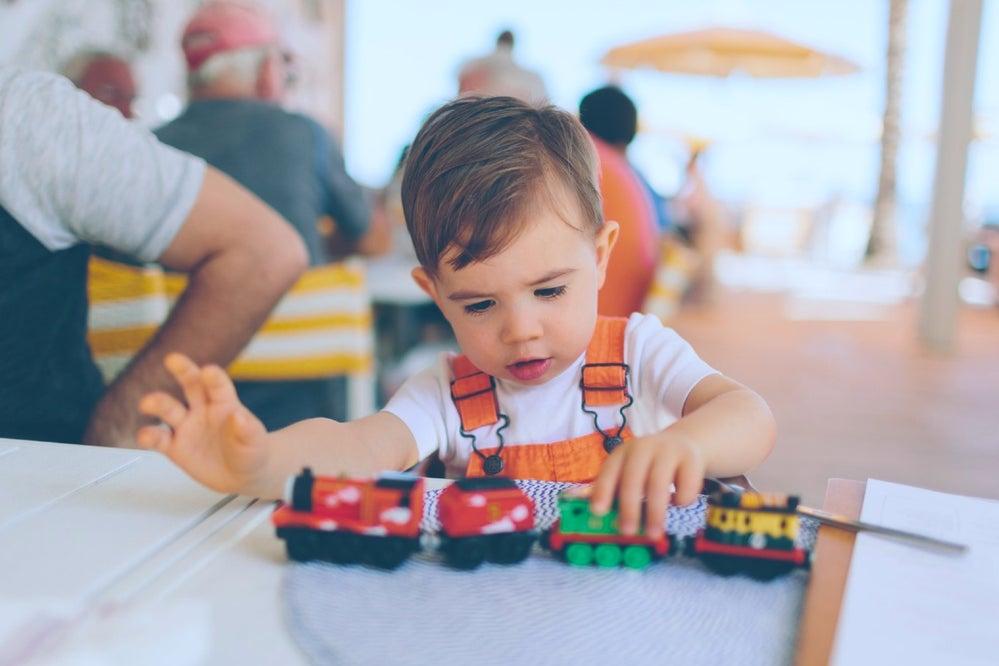
This stage overlaps with solitary and onlooker play. With parallel play, toddlers are continuing to add to their play repertoire, moving beyond the peripheral and getting themselves closer toward the centre of the action...or more aptly side-by-side the action. Here, children play next to each other with the same toy or activity, but they do not necessarily play together or even interact much. Picture two tykes, belly down on the floor building separate block structures or pushing their own choo-choos in opposite directions—or a handful of kids colouring or moulding clay at a shared table.
It may seem like your kid is simply ignoring their playmate, but the reality is your child is starting to figure out how exactly to engage with their peers...plus, they are practicing new play skills. To encourage parallel play, keep playdates small, adding just one or two kids to the mix so your child does not become overwhelmed. Offer the group shareable toys, like a bin or blocks, cars, action figures, or stuffed toys—or set up colouring books, sticker pages, or play dough.
Associative Play: 3 to 4 Years
Exciting development: Your kid’s attention span is getting longer and they are starting to crave some kid-on-kid interaction during playtime! You will notice your child getting more into activities like playing dress-up with other children, sharing a toy kitchen or tool bench, or using the playground equipment with their peers. This all falls under the umbrella of associative play.
Here, each kid is still focused on themselves, making up their own rules or pretend storylines...and the play itself is unstructured with no common goal. However, your child is talking with other children and sharing play supplies, which helps to improve language and problem-solving skills—and introduces turn-taking and social cooperation. Plus, it is the first step toward building friendships! (By the way, enrolling children in nursery school offers many ways to feed their newfound desire to play with others.)
Cooperative Play: 5+ Years
Is your kid playing, pretending, or creating with another child or children? Congrats! Your wee one has entered the cooperative stage of play, complete with rules and/or group goals. Now all of what they learned throughout the other stages of play will be put to good use as your child navigates how to compromise, take turns, share, engage in conflict resolution, and regulate their topsy-turvy emotions. (No small feat!)
To help nurture your child’s developing cooperative play skills, continue with small playdates, but now encourage short activities with clearly defined rules, like a round of 'Go Fish' or a game of kickball. You will also notice that some earlier play favourites are now taking a cooperative bent: Side-by-side car play morphs into a racing game with rules, playing restaurant and grocery store may trump simply pretending in the play kitchen, and individual dress-up may now have a coordinated theme or story.
For even more on how to nurture your child’s play skills, check out:
- 3 Types of Play Toddlers Need Every Day
- Playroom Ideas to Feed Your Toddler’s Curiosity
- How to Encourage Independent Toddler Play
- This Toy Trick is Sure to Spark Your Toddlers' Imagination
- Play Ideas for Baby
Avertissement : Les informations présentes sur notre site ne constituent PAS des conseils médicaux pour une personne ou une condition spécifique. Elles sont uniquement destinées à titre d'information générale. Si vous avez des questions médicales et des préoccupations concernant votre enfant ou vous-même, veuillez contacter votre fournisseur de soins de santé. Le lait maternel est la meilleure source de nutrition pour les bébés. Il est important que, en préparation et pendant l'allaitement, les mères adoptent une alimentation saine et équilibrée. La combinaison de l'allaitement au sein et au biberon dans les premières semaines de vie peut réduire la production de lait maternel de la mère et il est difficile de revenir sur la décision de ne pas allaiter. Si vous décidez d'utiliser une préparation pour nourrissons, vous devez suivre les instructions avec soin.
Principales actualités






PARTAGER CET ARTICLE
CHOIX DES PARENTS
Meilleures ventes