BABY
How to Keep Little Ones Safe During a Heat Wave
As the temperature rises, so does your baby’s risk of heat-related illness. Here is how to stay cool all summer long.

Écrit par
Happiest Baby Staff
For most healthy grownups, a heat wave is a sweaty and uncomfortable annoyance, but for babies and children, extreme heat can prove dangerous. The Department of Health & Social Care notes that infants and children up to 4 years old are among those at the greatest risk for heat-related illness, such as heat exhaustion, dehydration, and heat stroke. In fact, exposure to steamy temps in the summer is associated with higher rates of emergency-room visits for children, according to Harvard university research. That is because your child’s body temperature rises much faster than yours, they cannot yet properly regulate their body temperature, and they sweat less, which makes cooling down way more difficult. Not to mention, a toddler in motion is like a tiny furnace (PS: Heat waves are also dangerous for pregnant folks, increasing risk of problems like preterm birth and low birth weight.)
Since the heat waves keep coming—and are lasting longer than ever—it is important to learn how to effectively keep your baby or toddler safe and cool throughout the summer swelter. Here, 11 ways to keep your baby cool.
Stay inside.
Stay indoors between 10am and 2pm, when the sun is at its most punishing! And when the heat index is at or above 32 degrees Celsius, keep little ones inside no matter the time. (Check out these 20+ fun indoor activities for toddlers when it is too hot to go outside.) Indoors, keep the temperature between 20 to 23 degrees Celsius. That is the safest temperature range for sleep and it ensures that your baby or toddler is comfortable. While it might be tempting to put your baby right next to an AC unit—do not! They will get too cold. If you are struggling to find a cool-enough spot in your home, remember that lower floors will be cooler.
Cover the pram like this.
Do not completely cover your child’s pram with a muslin blanket. While this is great at shielding your child from the sun, it also traps heat, increasing the temperature of the pram and your baby. Make sure you allow a breeze to come in under the blanket—or use a large canopy or mesh sun shield that has been specially designed for prams. These provide shade along with adequate airflow.
Avoid fans in extreme heat.
According to the Department of Health & Social Care, fans should be avoided when the temperature reaches the high 30s. That is because fans are not actually cooling the air but moving hot air around. In fact, when you opt for a fan when the temperature is higher than your body temperature you may cause your baby’s body to get hotter! If the summer swelter is in the 20s or low to mid 30s, however, feel free to use a fan. Simply be sure to keep it at a safe distance from your baby to help avoid any safety mishaps, like pinched fingers.
Create a DIY air conditioner.
If you do not have access to an air conditioner, consider spending the day where the AC is pumping, like at the library, shopping mall, a cooling station…or Grandma’s! If all else fails, try placing a bucket of ice in front of your fan. When the air from the fan passes over the ice, it gets chilled—and then it circulates around the room!
Offer a lukewarm sponge bath.
Do not put your too-hot baby or bigger kid in an icy or cool bath! The cold water can increase their core body temperature, causing shivering. Instead, sponge your little one down in lukewarm water or apply a cold compress to your sweet pea’s forehead, neck, arms, and legs. Spritzing your kid's skin with a mist of cool or room-temperature water throughout the day is helpful, too.
Keep them hydrated.
Babies can become dehydrated very quickly in hot weather—which then increases their body temperature even more! To keep your baby hydrated, you will not necessarily use water! While it is okay to give your 6- to 12-month-old 110 to 230 milliliters of water a day, babies under 6 months get all the hydration they need from either breastmilk or formula. So, on hot days, offer more of the same. Kids between the age of 1 and 3 need roughly 6-8 120-150ml cups a day, including water or milk. This bumps to around 250-300ml cups for 4- to 8-year-olds. So, you will also want to increase these amounts during hot days.
Serve fruit.
Eating fruit that has high water content can help your solids-eating baby or big kid fend off the heat and stay properly hydrated. Some kid favourites include watermelon, cantaloupe, strawberries, peaches, and cucumbers. Homemade fruit pops or smoothies do the trick, too!
Get blackout curtains.
Shading your baby’s room—and the whole house—with closed curtains can be an easy-peasy way to reduce the heat. The trick is to draw a set of thermal curtains that not only blocks the sun’s rays, but works to keep out the heat, too. These types of blackout curtains create a barrier to prevent air from entering or leaving, keeping your room cool (or warm!) depending on the season. (If you do not have AC, open the windows and doors behind the curtain.)
Be car smart.
Never ever, ever leave your baby or child in a car. Car temperatures can reach dangerous levels no matter if you are parked in the shade or the sun—or if it is summer or fall! In fact, researchers estimate that even in a shaded vehicle, a 2-year-old’s core temperature could reach a potentially deadly 40 degrees Celsius in less than two hours. While most hot car deaths are due to forgetting your child in a vehicle, 26% of accidental hot car deaths are due to a little one getting into an unattended car, making it extremely important to always lock your vehicle! And to keep your baby comfortable and heat-safe when driving, add a window shade or tinted cling to the backseat window to keep direct light off your baby. If you can, run the AC before placing your baby in the back. Finally, consider The Noggle, which is a lightweight, flexible tube that you easily attach to your car’s front seat vent to funnel cool air to your backseat dwellers. This is especially helpful for kid’s in rear facing car seats and furthest away from cooling vents.
Stick with cooler fabrics.
Whether you are dressing your baby in a short-sleeve bodysuit or grabbing a bassinet sheet, stick with breathable cotton. Synthetic fabrics trap heat, making your little one more uncomfortable. (That means that waterproof sheets can make Baby hot, too.) When out and about, opt for light-coloured, loose-fitting clothes which cover your little one’s arms and legs.
Enjoy water safely.
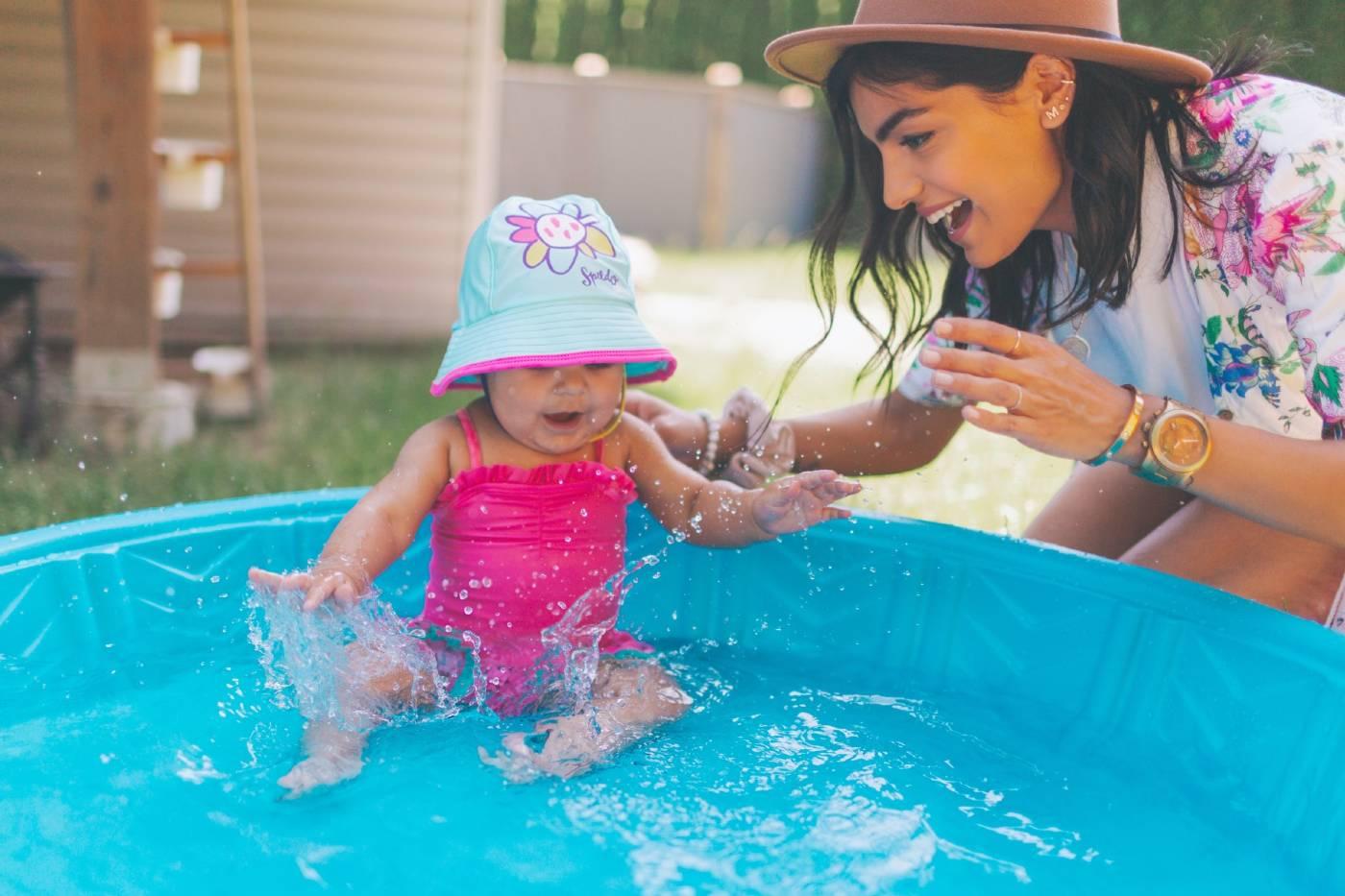
If you are cooling off at the pool or in the sprinkler, put your baby in SPF protective clothing and a wide-brimmed sun hat with air vents. (Learn more about kids and water safety.) And, of course, seek shade! Babies under 6 months old should not be in direct sunlight. When adequate clothing and shade are not available, apply a small amount of mineral sunscreen (at least SPF 15) to Baby’s face, neck, and back of hands. Do not forget: Sunscreen takes 30 minutes to be effective!
Signs Your Baby is Too Hot
Babies cannot tell you they are hot…and honestly, most toddlers are not A+ communicators either. That means it is up to you to monitor your child during a heat wave to ensure that they are not getting too hot. Here are some signs your little one may be overheating:
Signs of Heat Exhaustion in Children
- Cool, clammy, pale skin
- Increased thirst
- Extreme tiredness
- Muscle cramps
- Nausea and vomiting
- Irritability
- Headache
- Increased sweating
- Fainting
Mild symptoms can be treated at home with fluids and rest. If your toddler's symptoms do not resolve with treatment, or your little one’s symptoms are more severe, see a healthcare provider ASAP.
Signs of Heatstroke in Children
- Hot and dry skin
- High fever over 40 degrees Celsius
- Severe headache
- Dizziness and confusion
- Rapid breathing and heartbeat
- Little or no sweating (More than 50% of children with heatstroke do not sweat.)
- Seizures
If your child has symptoms of heatstroke, get medical care immediately and try to cool them down until help arrives.
Signs of Dehydration in Children
- Very dark yellow or orange urine
- Fewer than six wet nappies a day (infants)
- No wet nappies for eight hours (toddlers)
- No interest in taking a bottle or breastfeeding
- No tears when crying
- Dry mouth, tongue, and lips
- Excessive sleepiness
- Irritability
- Pale, dry, and/or wrinkled skin
- Cool and blotchy hands and feet
- Sunken soft spot (fontanelle)
- Deep, rapid breathing.
Signs of Heat Cramps in Children
- Muscle cramps in the calf or thigh and stomach
- No fever
- Possible tightness or spasms of the hands.
Drinking fluids and cooling down will usually resolve heat cramps in a few hours.
More summer safety advice:
- Summer Safety Tips for Babies and Kids
- Mosquito SOS!
- Does Your Baby Need Swim Lessons?
- Smart Sunscreen Tips for Babies and Kids
Avertissement : Les informations présentes sur notre site ne constituent PAS des conseils médicaux pour une personne ou une condition spécifique. Elles sont uniquement destinées à titre d'information générale. Si vous avez des questions médicales et des préoccupations concernant votre enfant ou vous-même, veuillez contacter votre fournisseur de soins de santé. Le lait maternel est la meilleure source de nutrition pour les bébés. Il est important que, en préparation et pendant l'allaitement, les mères adoptent une alimentation saine et équilibrée. La combinaison de l'allaitement au sein et au biberon dans les premières semaines de vie peut réduire la production de lait maternel de la mère et il est difficile de revenir sur la décision de ne pas allaiter. Si vous décidez d'utiliser une préparation pour nourrissons, vous devez suivre les instructions avec soin.
Principales actualités






PARTAGER CET ARTICLE
CHOIX DES PARENTS
Meilleures ventes