BABY
How Do Babies Learn to Talk?
Track your baby’s language development to find out what to expect when!
Écrit par
Happiest Baby Staff
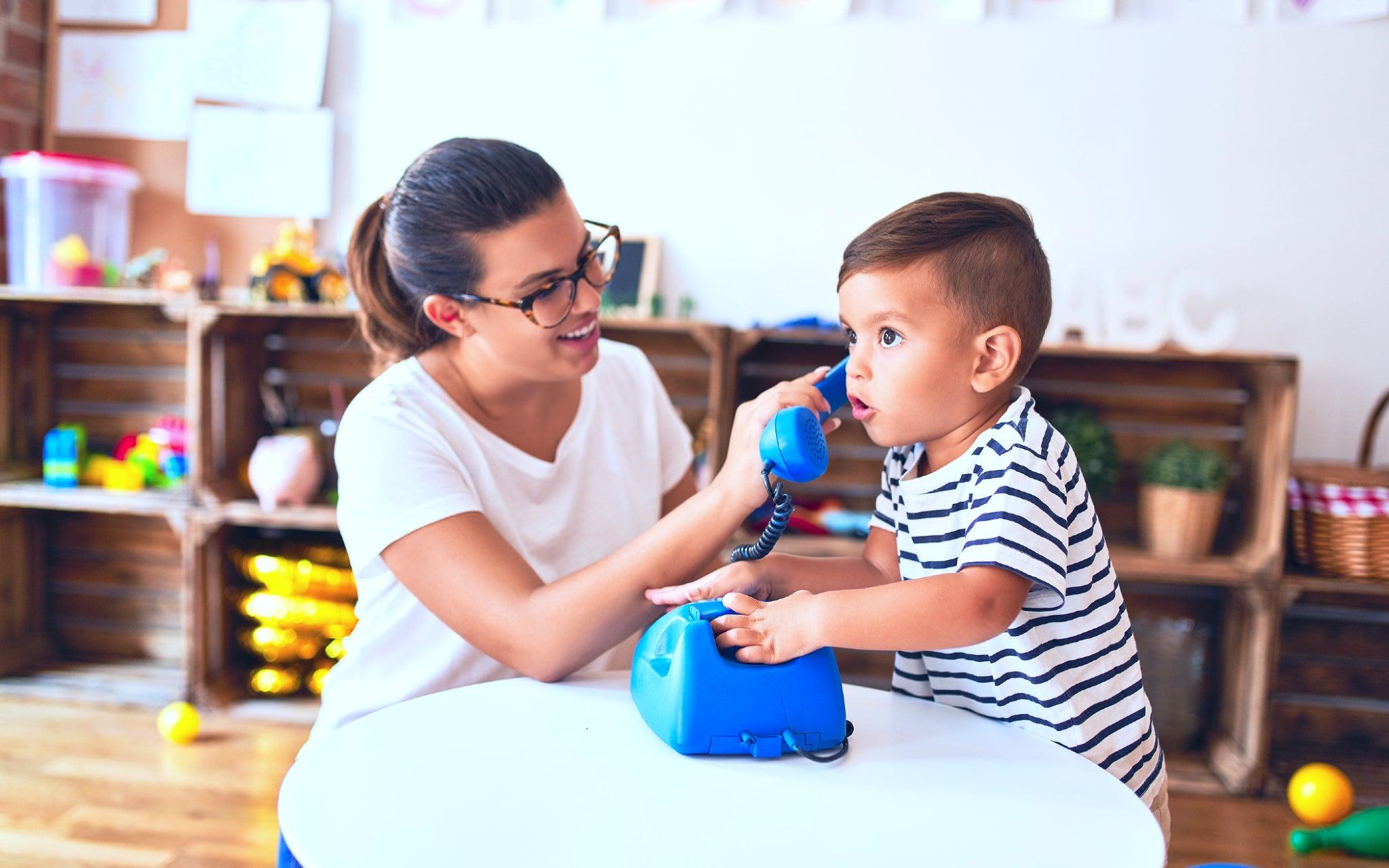
When you really think about it, it is hard to learn how to talk! Your baby’s lips, tongue, throat, and brain need to demonstrate some masterful teamwork to spit out just one word. It will likely take a whole year—or more—for your baby’s vocabulary to grow to one, two, or three words. In fact, most children are 2 to 3 years old before they get really good at speaking. So, what gets them to that point? Here, we will walk you through—stage-by-stage—how your little one goes from babbling cutie to a sentence-spewing toddler!
Language Development: 0 to 4 Months
As soon as your baby is born, they start gathering intel about what language is and how it works. They are busy tuning into the sounds you are making and witnessing how you communicate with others. (For instance, thanks to you, they quickly pick up on conversation basics, like, 'I cry, and someone responds.') At the start, your little one is more interested in your pitch and volume than what you actually say. (That is one of the reasons shushing your baby is an integral part of the famous calming 5 S’s. It is also why babies respond to the higher-than-normal and more varied pitch of babytalk.)
All this listening lays the groundwork for the starter vocabulary that emerges around 4 months, complete with distinct coos, bleats, and yelps that communicate specific needs. You will start to notice that your little nugget now waits for you to stop talking before taking a turn cooing. Or they might start to repeat one sound throughout the day.
Language Development: 5 to 7 Months
The heart-melting coos are in full effect...and so is some early 'talking!' Here, your baby’s 'words' sound a whole lot like gibberish. But if you really tune in, you will notice that your baby is mimicking the sounds of speech and your speech patterns. For instance, your little one may raise and drop their voice like you do when asking a question and start copying sounds you make. (Babies this age are especially good at repeating sounds that begin with p, b, and m.) Take advantage of all this undivided attention your nugget is giving you by talk, talk, talking all day long using your normal vocabulary, while paying special attention to your use of simple and familiar one- and two-syllable words, like baby, dog, or cold. The best part? Laughing starts about now! While all babies develop at their own unique pace, know that if your 7-month-old has yet to babble or imitate sounds, it is important to get their hearing tested .
Language Development: 8 to 12 Months
All the coos and bleats your baby loves to utter are slowly morphing into syllables you recognise, like ba and da. And once your little can say ba and da, bye and dada are not far behind! Still, the bulk of your baby’s 'words' remain difficult to interpret until the end of their first year (or more likely, later). That does not mean your baby cannot understand you, though! In fact, by now, your bundle of cuteness should be able to respond to their own name. Plus, when you say things like, go find your lovey!, they can grab their beloved SNOObear. When you ask, where is the kitty? They can point to the tabby cat.
Speaking of gesturing: A toddler who points to an object will likely learn the word for that object within three months! Twins, however, tend to take a bit longer to get the hang of pointing and waving, which leads to a slight lag in first words. Experts assure that this is usually nothing to worry about. To help all children reach their next milestone, play repetitive word games, like 'This little piggy,' point and name everything you see, and ask oodles of questions your baby can answer with a gesture, like where is your bottle?
Language Development: 1 Year
It is true that some kids boast a robust vocab of two to three words by their first birthday. However, it is more likely that your freshly minted 1-year-old is still talking a bunch of (adorable!) gibberish. As long as your little one is continuing to experiment with the intensity, pitch, and quality of sounds, coherent words are on the tip of their tongue!
'Coherent' does not always mean full words, though. Many toddlers begin talking with sounds that represent objects. For instance, bah-bah might be your bub’s word for bottle. (When you respond, simply use the word bottle, and eventually it will stick.) By about 18 months, your budding conversationalist could have as many as 10 words to draw from, including action verbs and directionals, like go, jump, up, and down. By this age, you start ditching your cute babytalk for some Toddler-ese. After all, your growing kid responds better when you speak slowly, using simple words and short sentences.
If you are raising your little one to be bilingual, do not worry if their vocabulary in each language is smaller than average. More than likely, their total vocab from both languages will be about the same size as a monolingual child.
Language Development: 2 Years
By the time your nugget turns 2 years old, there is a very good chance that their vocabulary will have ballooned to at least 50 spoken words. Those containing k, g, f, t, d, and n sounds are now more in play...and easier to say. Plus, two-word sentences (More cookie! No mama!) are in full effect. As the year inches on, those simple two-word sentences will snowball to four- or five-word sentences, like: Where is my kite, dada? (Bilingual? It is totally normal if your child mixes two languages in the same sentence.) You will notice that pronouns will start to eke into your child’s once caveman-like sentences, so want cup will become I want my cup.
Now is a fabulous time to read lots of engaging and simple books, sing catchy songs, and play word games. Your child is a little sponge, ready to absorb all the words! And, again, children develop at different rates. In fact, at this age, there are more discrepancies in language development than at any other age, with boys often developing a bit later than girls. That said, if you are at all worried about your child’s language development, reach out to your peadiatrician.
Language Development: 3 Years
Wow! By age 3, your smarty-pants toddler can likely spout off between 200 and 1,000 words...and their sentences are getting even longer! Articulation has greatly improved, too, which means you can understand about 75% of what your kid says to you. But know that 3 year olds may still have a tough time with some more difficult sounds, such as l, r, s, sh, ch, y, v, z, th. (Those may not be fully mastered till around the age of 7.) Conversations are getting a lot more fun, too. Your growing toddler should be able to answer simple who, what, where, and why questions and turn most everyday words plural when appropriate. They can also add -ing to verbs that need it and they will be able to join into rhyming games.
Continue to help your toddler build their vocabulary by adding onto their sentences and yes, even correcting their grammar. For instance, when your toddler says, I like the blue car, you can respond with, I like the big, bright blue car, too! If your child says, I no like juice, you can say I do not like juice. Finally, keep reading to your child! It is one of the best ways to bolster learning and vocabulary.
Avertissement : Les informations présentes sur notre site ne constituent PAS des conseils médicaux pour une personne ou une condition spécifique. Elles sont uniquement destinées à titre d'information générale. Si vous avez des questions médicales et des préoccupations concernant votre enfant ou vous-même, veuillez contacter votre fournisseur de soins de santé. Le lait maternel est la meilleure source de nutrition pour les bébés. Il est important que, en préparation et pendant l'allaitement, les mères adoptent une alimentation saine et équilibrée. La combinaison de l'allaitement au sein et au biberon dans les premières semaines de vie peut réduire la production de lait maternel de la mère et il est difficile de revenir sur la décision de ne pas allaiter. Si vous décidez d'utiliser une préparation pour nourrissons, vous devez suivre les instructions avec soin.
Principales actualités






PARTAGER CET ARTICLE
CHOIX DES PARENTS
Meilleures ventes