TODDLER
What's "Normal" Talking for a 2-Year-Old?
Here's what to expect at 24 months.

Escrito por
Happiest Baby Staff
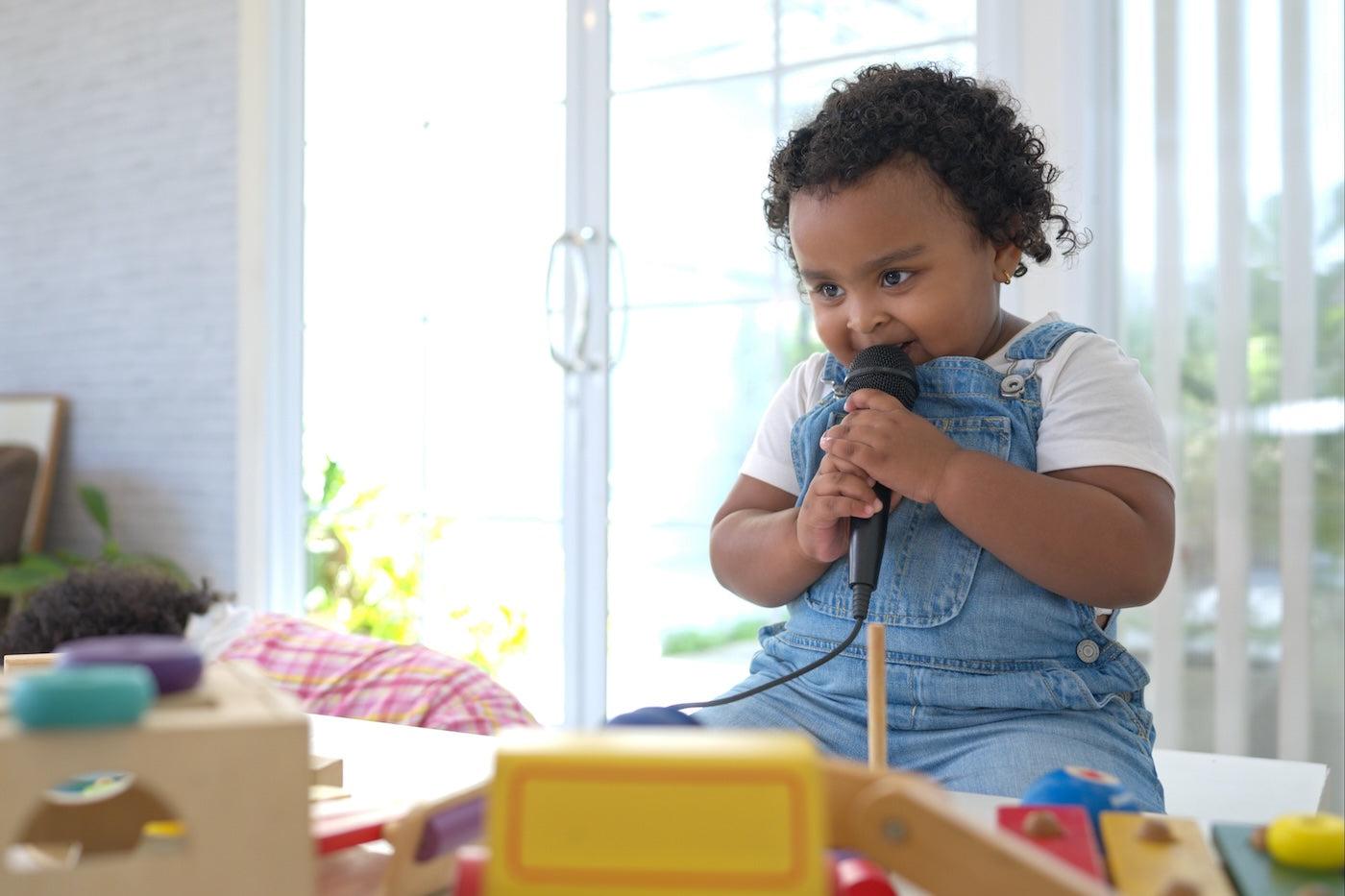
If you have a 2-year-old or a soon-to-be 2-year-old, chances are your home is filled with giggles, grunts, and growing chatter. Maybe your toddler’s asking for "more banana" or pointing out every dog they spot on a walk. Or perhaps they’re still mostly using gestures and a few favourite words. Either way, you might be wondering: What is 'normal' talking for a 2-year-old?
Good news: There's a lot of variation in how language develops at this age. So, before you start worrying about how many words your neighbour’s toddler is saying, let’s explore what speech and language typically look like at 2 years old—along with a few signs it might be time to speak to your GP or health visitor.
How many words should a 2-year-old say?
By the time that birthday cake is topped with two candles, most toddlers have at least 50 spoken words in their vocabularies, and many are already combining two or more into short phrases, like "more milk" or "go park."
But here’s the thing: The range of what’s “normal” is huge. Some 2-year-olds are saying nearer to 100 or even 300 words, while others are still warming up their verbal engines—and that can be completely fine! In fact, large studies of toddler vocabulary show just how wide that range can be. The Wordbank Project, which gathers data from thousands of children, found that the average 2-year-old says about 200 to 300 words.
What’s most important isn’t hitting a certain number—it’s seeing that your little one is making progress, experimenting with new words, and moving towards combining them. That’s the sweet spot we’re aiming for.
What kind of words do 2-year-olds use?
By now, your toddler is probably using words to label the people and things they love: "ball," "mum," "lorry," "biscuit." But they’re also beginning to express wants and feelings: "mine," "no," "all done!" (Let’s be honest, "no" might be a top pick!)
You’ll likely hear your little one mixing and matching words: "Daddy go work," "more book," or "me do it!" These short phrases are a big step—they show your toddler is starting to understand grammar, even if they haven’t mastered all the rules yet.
And yes, those early words might be adorably muddled. "Wawa" for water, "nana" for banana—it’s all part of the journey. Your little one’s mouth is still learning how to shape all those sounds, which is why many 2-year-olds are only about 50% understandable to adults. Even if you have to play a bit of a guessing game, your child is communicating!
How do toddlers communicate without words?
Even as their vocabulary grows, 2-year-olds still rely on body language, facial expressions, tone, and gestures to get their point across. They might point, grunt, pull you by the hand, or throw in a big dose of drama to make themselves heard.
You might notice your toddler:
- Echoing what you say (also known as “parroting”)
- Pointing to things they want or recognise
- Using tone of voice to express feelings
- Pairing words with gestures ("up!" while lifting their arms)
All of these are valid communication tools, helping build the foundation for full-blown conversation. When your child says "juice!" while pointing to the fridge, try expanding on it: "You want some juice? Let’s get your juice." Modelling richer language like this helps them learn more complex ways to speak.
What language milestones happen around 2?
Development isn’t one-size-fits-all, but the CDC and American Academy of Pediatrics outline some things many 2-year-olds can do around this age. For instance, most toddlers can:
- Use two words together, like "want toy"
- Say 50 or more words
- Point to pictures in a book when named
- Follow two-part instructions like "Get your shoes and come here"
- Know names of familiar people and objects
- Attempt to repeat words they hear
And remember: If your child isn’t doing every single one of these things, it doesn’t necessarily mean there’s a problem. Some toddlers take a little longer with speech while they focus on other skills (like climbing everything in sight!).
Why is my toddler so hard to understand?
Here’s a toddler truth: Even if your little one is saying lots of words, you might only understand half of them. That’s totally normal. Most 2-year-olds are still figuring out how to coordinate their tongue, lips, and brain to produce clear speech.
At this stage, you might notice:
- Missed syllables ("nana" for banana)
- Sound swaps ("wabbit" for rabbit)
- Jumbled word order ("Me go shop")
Experts say around 50% of a toddler’s speech should be intelligible by age 2. That rises to about 75% by age 3. Until then, be patient. Try repeating what you *think* they said to reinforce the correct version: "Oh, you want the red ball?"
What do 2-year-olds understand?
Even if your toddler isn’t saying much yet, they likely understand far more than they can say. By age 2, many toddlers can:
- Recognise hundreds of words
- Know names of familiar people, pets, toys, and body parts
- Follow simple instructions and daily routines
- Grasp basic concepts like "in", "on", "up", and "down"
So even if they don’t yet say, "I’d like a snack, please," they know what you mean when you ask, "Shall we get a snack?" Their growing understanding, responsiveness to questions, and engagement with books are all signs of healthy language development.
When to reach out about a speech delay
All children develop at their own pace, and many late talkers catch up on their own. But if something feels off, trust your instincts. According to the CDC, AAP, and ASHA, it might be worth having a word with your GP or a speech and language therapist if your child:
- Uses fewer than 50 words by age 2
- Isn’t combining words into short phrases
- Rarely tries to copy words or sounds
- Relies mostly on gestures to communicate
- Struggles to follow basic instructions
- Has lost words they previously used
There’s no harm in asking for advice—early support can be incredibly helpful. Your GP may refer you for a hearing test or to a speech and language therapist for a closer look.
The bottom line on talking at 2
Every toddler takes a unique path when it comes to learning language. Some are singing nursery rhymes already, while others are just beginning to string a couple of words together—and both are perfectly normal.
If your child is showing signs of progress—understanding more, experimenting with new words, combining gestures and speech—that’s a great indicator they’re on the right track. Keep chatting, reading, and singing with them. You’re their favourite teacher—and their favourite person to talk to
Before long, you’ll be hearing all about their day at nursery. But for now, enjoy the sweet sound of "mummy up!" and "me do it!"—these are the building blocks of brilliant communication.
More on Toddler Development:
- Conversation Starters to Get Your Tot Talking
- Science-Backed Ways to Boost Language Development
- How Toddlers Learn Through Play
***
REFERENCES
- Centers for Disease Control and Prevention: Important Milestones – 2 Years
- Wordbank Project, Stanford University
- Zero to Three: Your Child’s Development: 24 Months
- Early Vocabulary Development in a Nationally Representative Sample of Children, Journal of Speech, Language, and Hearing Research, October 2021
- American Speech-Language-Hearing Association: Communication Milestones – 2 to 3 Years
Descargo de responsabilidad: La información en nuestro sitio NO es un consejo médico para ninguna persona o condición específica. Solo se proporciona como información general. Si tiene alguna pregunta o preocupación médica sobre su hijo o sobre usted mismo, por favor contacte a su proveedor de salud. La leche materna es la mejor fuente de nutrición para los bebés. Es importante que, en preparación para la lactancia y durante la misma, las madres lleven una dieta saludable y equilibrada. La combinación de lactancia materna y alimentación con biberón en las primeras semanas de vida puede reducir la producción de leche materna y es difícil revertir la decisión de no amamantar. Si decide utilizar fórmula infantil, debe seguir las instrucciones cuidadosamente.
Principales noticias






COMPARTIR ESTE ARTÍCULO
ELECCIONES DE LOS PADRES
Más vendidos