PARENTS
How to Safely Return to Exercise After Baby
Whether you’re itching to move or dreading workouts, here’s all you need to know about safely engaging in physical activity after your baby is born.

Geschrieben von
Happiest Baby Staff
When you’re both caring for a newborn and recovering from birth, finding the time, energy, and motivation for exercise can be…challenging to say the least! But rising to that challenge is pretty important. Experts agree that gently moving your body after birth can help you heal and recover, and possibly decrease feelings of depression, too. That’s great to know, but there’s a good chance you still have a ton of questions, like: How soon after giving birth can you work out? What exercises are safe after pregnancy? And of course, How and when will I ever manage to find time to exercise again?! For answers—plus some easy-on-you postnatal exercises to try—keep reading!
What are the benefits of postnatal exercise?
You already know that there are myriad perks to exercise—and that physical activity is good for overall health. But here’s a breakdown just some of the potential benefits of physical activity after baby:
- Improves sleep quality
- Strengthens pelvic floor muscles
- Improves cardiorespiratory fitness
- Boosts energy
- Decreases depressive symptoms
- Lifts mood
- Maintains a healthy weight
- Relieves stress
- Strengthens and tones abdominal muscles
Can exercise help correct diastasis recti?
Yes! Diastasis recti occurs when the internal pressure of your full-with-baby uterus partially or fully separates the two muscles that run down the middle of your tummy. This not only weakens your core strength, it can also create a belly bulge. The good news? Certain postnatal abdominal strengthening exercises have been shown to decrease the incidence of diastasis recti abdominus and decrease the inter-rectus distance, too, according to the American College of Obstetricians and Gynecologists (ACOG).
Can exercises help treat postnatal incontinence?
Yes. Pregnancy and childbirth can weaken the pelvic floor muscles that are responsible for cradling your uterus, bladder, and rectum. When these important muscles become weak during pregnancy, you may wind up with urine leakage and/or pelvic organ prolapse, which is when one or more of these organs drops or presses into—or out of—the vagina. Strengthening these muscles after birth with targeting exercises (like Kegels), however, can help prevent and treat these postnatal complications. In fact, ACOG urges new parents to prioritise pelvic floor exercises after birth. But it’s important to be cautious about the type of postnatal abdominal and pelvic muscle exercises you engage in after pregnancy. Quickly returning to high-intensity core workouts can strain your weakened abs and pelvic muscles, causing pain and further injury. Start gently and consult with your healthcare team to see if you’d benefit from seeing a pelvic health therapist who can devise a pelvic-floor focused exercise routine for you.
When can you start postnatal exercise?
ACOG recommends gradually resuming exercise after delivery by first incorporating gentle pelvic floor exercises, like Kegels, into your day. Then, a few days after your baby arrives, begin taking daily 30-minute walks at a slow to moderate pace. If a half hour is too much, simply do what you can without overextending yourself. Remember, even 10 minutes of physical activity benefits your body. (Always stop exercising if you feel any pain or discomfort.)
If you’re a seasoned gym rat, a runner, a Peloton devotee, or a similarly high-intensity type of exerciser, do not think you get a special pass to return to your workouts sooner than others!
Most new parents who gave birth vaginally without complications should wait at least 12 weeks before easing back into intense workouts, such as running or lifting weights, according to the 2019 guidelines endorsed by the Association of Chartered Physiotherapists in Sports and Exercise Medicine. This postnatal pause has been shown to reduce the risk of hernia, muscle tears, falls, urinary incontinence, and pelvic organ prolapse. Be sure to talk to your midwife or doc about your return-to-fitness timeline during your six week postnatal checkup. Your healthcare provider may suggest waiting longer than 12 weeks if you…
- Are dealing with diastasis recti
- Had a cesarean section
- Have excessive scar tissue in the pelvic area
- Experienced perineal tearing
- Were classified as obese prior to pregnancy
Postnatal Exercise: Goals and Expectations
When you’re ready, it’s recommended that you engage in at least 150 minutes of moderate-intensity aerobic activity (raised heart rate, sweating) throughout the week. That shakes out to a minimum of 2 hours and 30 minutes stretched over a 7-day period—or 30 minutes a day, five days a week. You can even pepper 10-minute sessions through each day.
The key phrase here is “when you’re ready.”
Remember, just because you’re no longer pregnant does not mean your body has magically transformed to your pre-pregnancy state! It takes between 6 and 8 weeks after birth for your uterus to contract to its normal size, about 8 weeks for the separation between your stomach muscles to go back to their starting position, and your hormones generally don’t normalise for three to six months postnatal. Your postnatal workout should look different than your pre-pregnancy exercise routine! Instead of aiming to pick up your old routine where you left off, it’s a better to make the following your get-moving goals:
- Progress gradually.
- Listen to your body.
- Prioritise rest (sleep deprivation is associated with increased risk of injury during physical activity).
- Evaluate your current capabilities.
- Focus on slowly regaining strength in the muscles weakened during pregnancy.
- Ask for support so you can work physical activity into your new routine.
Take special note of that last to-do. A 2021 report in BMC Pregnancy and Childbirth concluded that it’s exceedingly difficult for new mums to return to physical activity—and to sustain their motivation—in the postnatal period without proper support. That means, turn to your partner, family, friends, and other caregivers for help scheduling your get-active time—and for help holding down the fort while you focus on you.
Will exercise affect breastmilk supply?
Rest assured that regular aerobic exercise will not negatively impact your breastmilk production, composition, or your baby’s growth, according to ACOG. There’s some research that suggests high-intensity exercise may create a buildup of lactic acid in breastmilk, causing it to taste a bit sour, but that’s a rare occurrence. If you’re feeding your baby breastmilk, here are some things to keep in mind while exercising:
- Consider breastfeeding your baby before working out to avoid the discomfort of engorgement.
- Drink plenty of water before—and during—your workout.
- Wear a supportive, well-fitted sports bra while exercising.
- Consider nursing pads to help with breastmilk leaks.
- Don't overdo it! Stress and fatigue can reduce your breastmilk supply.
Gentle Postnatal Exercises
Before jumping into a postnatal exercise routine, consult your healthcare provider. With that, here are some gentle moves to consider including:
- Kegel Exercises: Contract your pelvic muscles, like you’re trying to stop pee midstream. Hold for up to 10 seconds and release, then relax for 10 seconds. Shoot for a minimum of three sets of 10 reps a day. (Don’t do your Kegels while peeing! This can lead to not fully emptying of your bladder, increasing your chance of a UTI.)
- Belly Breathing: This exercise not only promotes relaxation, it’s a gentle strategy to improve core strength, too. Find a comfy position sitting or lying down. Place one hand on your chest and the other on your belly and deeply inhale through your nose, allowing your belly to expand as you breathe in. (Don’t puff your tummy out!) Slowly exhale through your mouth, allowing your abdomen to sink back down. Repeat for several minutes, gradually increasing the length of each inhale and exhale. (Use SNOObie’s Magic Breathing track to help guide you through this exercise.)
- Walking: It’s low-impact, can be done safely after birth, increases circulation and cardiovascular fitness, builds endurance, and—the best part—improves mood! You can even wear your baby while doing it.
- Pelvic Tilts: To target your abdominals, lie on the floor, on your back, knees bent. Tighten your abs and bend your pelvis slightly upward, all while keeping your back flat against the floor. Hold for up to 10 seconds. Repeat five times and work up to 10 to 20 reps.
- Happy Baby Pose: This move loosens tight pelvic floor muscles. Lie on your back and bring your knees toward your chest at a 90-degree angle. Point the soles of your feet toward the ceiling. (Keep your feet flat, like you might walk on air.) Reach forward, hold your feet, and spread your knees apart, slightly wider than your hips. Focus on relaxing your pelvic muscles and hold this pose for about 90 seconds.
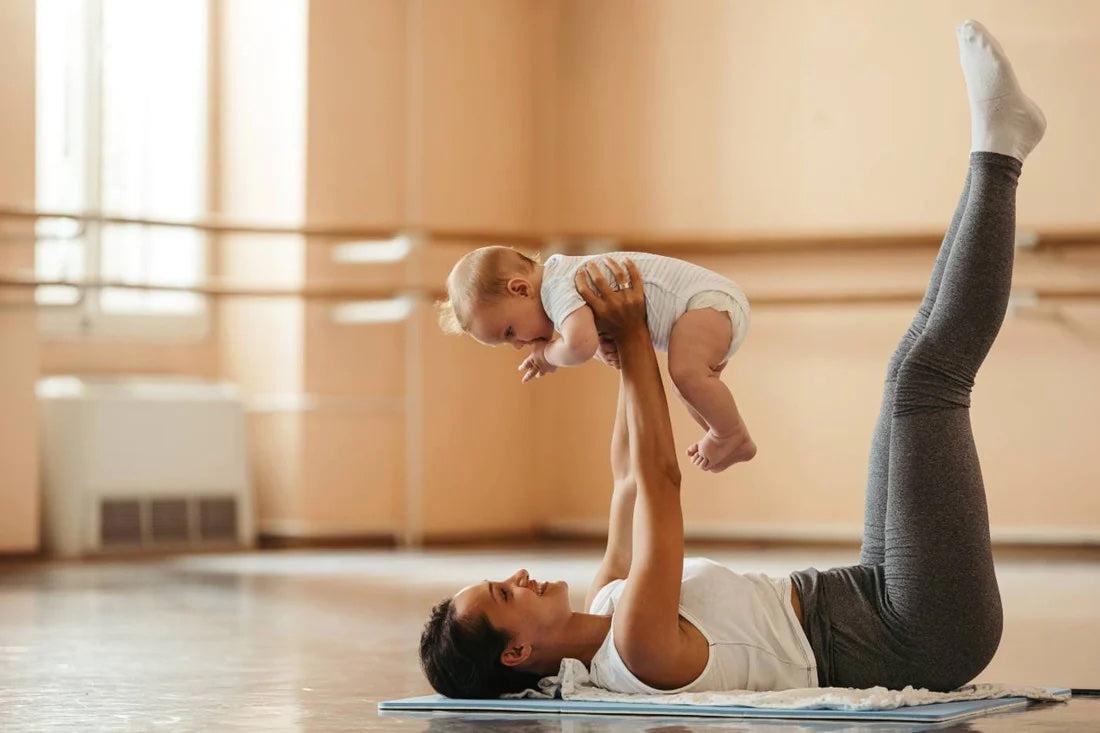
- Baby Lifts: You can start this baby-focused chest, arms, and shoulder workout about 2 to 4 weeks after delivery. Stand with your feet hip-width apart and bend slightly at the knees. Hold your baby with both hands so their sweet face is even with yours. Making sure you stabilise your bub’s head and neck, slowly lift your little one straight up, then slowly lower them. Start with 10 reps, then progress to 30, then 50. (Don’t do this after a feeding!)
- Knee Drops: Lie on the floor and, keeping your back flat, engage your core. (Pretend your navel is getting pulled toward the floor to meet your spine.) Next, bend your knees and place your feet on the floor hips-width apart. Slowly let one knee drop to the side, then bring it back to center. Repeat on the other side. When you feel stronger, try lowering both knees at the same time. (This gentle core workout should be a-okay to do two to six weeks after delivery.)
- Clamshells: Lie on your side with knees bent and together. Keeping your back straight and feet together, slowly lift your top knee toward the ceiling. Roll over to the side and repeat, eventually working up to a set of 25. The goal is not to go as far as you can! Instead, do what’s comfortable to work out your hips and glutes. (You can likely start between week 4 and 6 after Baby.)
***
REFERENCES
- Houston Methodist: Postpartum Exercise: What to Know About Exercising After Pregnancy
- Reconciling relationships with physical activity: a qualitative study of women’s postnatal physical activity decision-making. BMC Pregnancy and Childbirth. January 2021
- Physical Activity Guidelines for Americans, 2nd edition, U.S. Department of Health and Human Services. 2018
- Mayo Clinic: Exercise after pregnancy: How to get started
- American College of Obstetricians and Gynecologists (ACOG): Physical Activity and Exercise During Pregnancy and the Postpartum Period
- U.S. Department of Health and Human Services, Office on Women’s Health: Pelvic organ prolapse
- Right as Rain by UW Medicine: Surprising Reasons You May Need Pelvic Floor Therapy
- ACOG: Exercise After Pregnancy
- UTSouthwestern Medical Center: Postpartum exercise: When it's safe to start running and lifting after pregnancy
- Returning to running postnatal – guidelines for medical, health and fitness professionals managing this population. Physios in Sports. March 2019
- University of Missouri Health Care: The Science Behind the “Mom Bod”: Permanent and Temporary Changes Caused by Pregnancy
- The National Health Service (NHS): Your post-pregnancy body
- Hackensack Meridian Health: What Happens to Your Hormones After Birth?
- UTSouthwestern Medical Center: 10 exercises you can do with your new baby
Haftungsausschluss: Die Informationen auf unserer Website sind KEINE medizinischen Ratschläge für eine bestimmte Person oder einen bestimmten Zustand. Sie sind lediglich als allgemeine Informationen gedacht. Wenn Sie medizinische Fragen und Bedenken bezüglich Ihres Kindes oder Ihrer eigenen Gesundheit haben, wenden Sie sich bitte an Ihren Gesundheitsdienstleister. Muttermilch ist die beste Quelle der Ernährung für Babys. Es ist wichtig, dass Mütter in Vorbereitung auf das Stillen und währenddessen eine gesunde, ausgewogene Ernährung zu sich nehmen. Die Kombination von Stillen und Flaschenernährung in den ersten Lebenswochen kann die Muttermilchversorgung verringern und die Entscheidung, nicht zu stillen, ist schwer rückgängig zu machen. Wenn Sie sich entscheiden, Säuglingsnahrung zu verwenden, sollten Sie die Anweisungen sorgfältig befolgen.
Top-Nachrichten






DIESEN ARTIKEL TEILEN
ELTERN WAHL
Bestseller