BABY
Why Do Babies Cry in Their Sleep?
How to figure out what your baby’s cries mean and when you should intervene.

Geschrieben von
Happiest Baby Staff
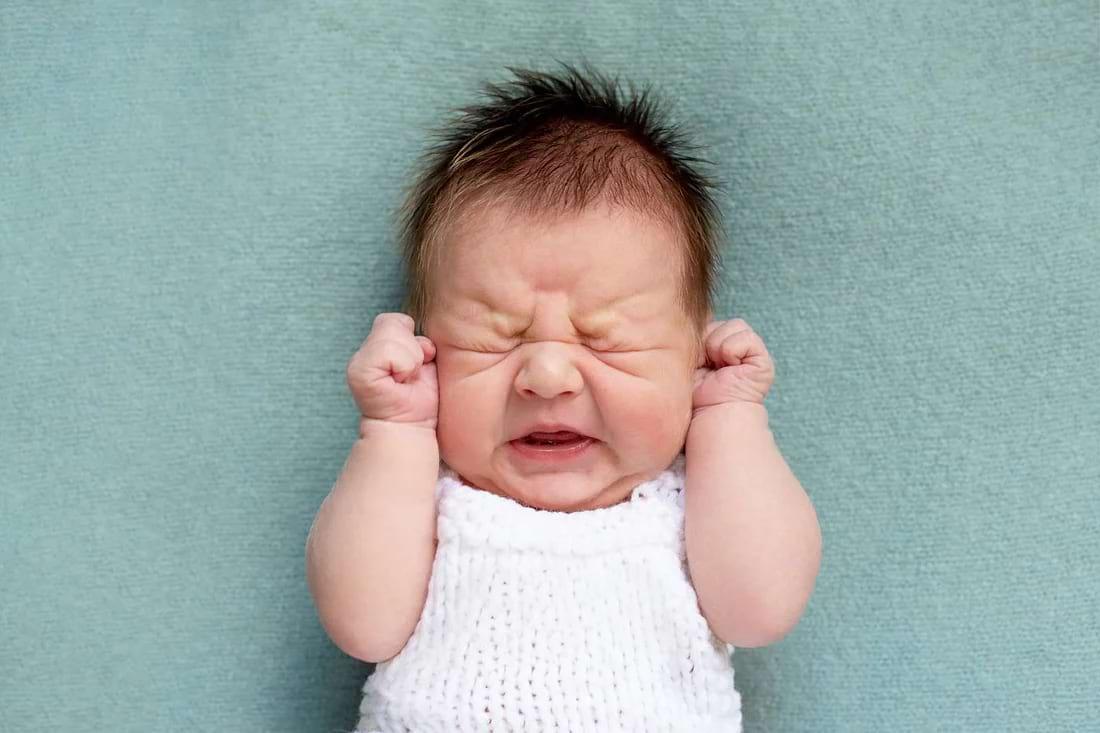
We’re all pretty familiar with the phenomenon of talking in your sleep and even walking in your sleep…but crying in your sleep? For babies, crying while sleeping is a normal and expected behavior! But questions remain: Why do babies cry in their sleep? What do you do if your baby cries in their sleep? And is Baby crying in their sleep something to worry about? Here, all the answers you’re looking for!
Why do babies cry in their sleep?
Suddenly hearing your sweet sleeping baby cry out from their bassinet is jarring and sometimes worrisome. There are several common reasons that your baby might cry during sleep.
Babies cry in their sleep because of short sleep cycles.
Newborn babies spend about half their sleeping hours in rapid eye movement (REM) sleep. REM sleep is also dubbed “active sleep”—and for good reason! During REM, babies twitch and jerk, their tiny mouths move, their closed eyes flutter…and they can whimper and cry, too. And because newborns cycle back to active sleep about every 45 to 50 minutes, crying in their sleep can occur throughout their ZZZs. All of this is 100% normal and nothing to worry about!
Babies cry in their sleep because they’re hungry.
Babies have tiny tummies, and they grow rapidly, so they get hungry a lot...including throughout the night. Breastfed newborns wake to feed about every 2 to 3 hours and formula-fed babies do so roughly every 3 to 4 hours. And since crying is your little one’s only form of communication, that’s how they let you know they need a bite to eat. (Unsure if feeding is the answer? Here, signs your baby is hungry.)
Babies cry in their sleep because they want to suck.
Babies love to suck! That’s why sucking is part of the game-changing 5 S’s for soothing babies. However, if your baby snoozes with a dummy and the dummy falls out, tears are a likely side effect.
Babies cry in their sleep because of the startle reflex.
Your baby’s nervous system is a work in progress, which means their innate reflexes are in full effect...and can disrupt sleep. For example, your little one’s startle reflex (aka the moro reflex) can cause wild hand motions that can easily bonk themselves in the face, causing tears.
Babies cry in their sleep because they’re uncomfortable.
Dirty or wet diapers, a too-hot or too-cold sleep environment, teething pain, wayward light streaming through the window or door cracks, or a doggie barking in the distance can all disturb a snoozing baby, bringing on middle-of-the-night crying.
Babies cry in their sleep because they’re overtired.
While you’d think an overtired baby would be able to sleep anywhere and do so soundly, that’s often not the case! When babies are wired and tired, they not only struggle to settle down, they struggle to remain asleep, too. That’s because being overtired causes cortisol—a fatigue-fighting hormone—to run rampant in your little one, disturbing sleep.
How to Interpret Baby Cries
Just as adults use a variety tones to express different emotions, babies use a range of cries to convey different needs. Here’s a little help to distinguish your baby’s cries when they’re sleeping:
- Baby’s whimpering often reveals that they’re moving from one sleep cycle to another or that they’re slightly unhappy, perhaps due to a bit of teething pain. Think of these mild fussing sounds more of a gentle request or a natural transitional sound rather than a complaint that demands immediate attention.
- Sudden and strong cries that escalate quickly—and don’t quiet after a couple of minutes—often mean your baby wants your attention, perhaps due to hunger or a soiled diaper.
- A piercing, glass-shattering wail can mean Baby is in pain or experiencing some sort of irritation.
Do babies have nightmares?
Don’t worry, your little one is not crying in their sleep because they’re having a nightmare! In fact, infants and babies don’t even experience dreams until they’re around 2 years old. And even then, toddler dreams aren’t really like grownup dreams. Instead, toddler dreams are like snapshots or a slideshow, featuring friendly animals and other familiar sights, like images of their family eating dinner. Nightmares or night terrors most often occur in school age kids, but children as young as 4 years old may experience them, too. And, while rare, babies as young as 18 months old have been known to have night terrors as well. (Learn more about toddler nightmares.)
How to Calm Babies Who Cry in Their Sleep
Different sleepytime tears call for different soothing methods. In fact, it’s often best to ignore some middle-of-the-night baby cries. (Waking a crying baby might even upset them more!) Follow this rule-of-thumb when your baby cries at night:
- Don’t rush to soothe. Babies are naturally noisy and restless sleepers, so squeaks, squawks, and whimpering during REM sleep are the norm. If you can tune out your baby’s cries and screeches for just a few minutes, you might be surprised to find that your little one can settle themselves down.
- Turn on white noise. White noise is an essential element of the famed 5 S’s for soothing babies for many reasons. One of them being: White noise helps babies ignore slight internal sleep-disruptors (like teething pain) and external ones (like traffic or TV sounds). Plus, white noise mimics the constant soothing sounds Baby heard in the womb and has been shown to help 80% of infants fall asleep in just 5 minutes.
- Swaddle your baby. If you’re not already swaddling your baby with their arms down for all sleeps, start now. Snugly wrapping your little one in a lightweight swaddle can keep your baby’s startle reflex from waking them. (Unswaddled babies can easily and unintentionally bonk themselves in the face with their freewheeling arms, waking them up.) Plus, swaddling helps babies respond faster to the other soothing and sleep-inducing sensations, like white noise. (Once a baby can roll, swaddling must stop. But SNOO babies can remain safely swaddled until they’re ready to graduate to a cot.)
- Use a dummy this way. Pushing a dummy into your baby’s mouth when they’re crying is often doomed to fail. Instead, wait till your baby is calm. (Dummy sucking lowers Baby’s heart rate, blood pressure, and stress levels.) You can teach your little one to keep the dummy in their mouth by using a bit of reverse psychology. When Baby is sucking, gently tug on the dummy as if you’re going to take it out without actually taking it out. After a few times your baby will resist these little pulls…and suck harder, making the dummy less likely to fall out. (If you’re nursing, wait to introduce a dummy till breastfeeding is well-established.)
- Keep Baby at a comfy temp. Make sure your baby isn't too hot or too cold—touch their ears and cheeks to make sure. And dress them in only one more layer than what you’re comfortable in. That generally means Baby should sleep in a breathable, cotton bodysuit and a lightweight swaddle or sleep sack.
- Be boring. When you go to help calm your baby who’s crying in their sleep, keep your interaction quiet and calm. That means, change Baby’s diaper or offer a feed without unnecessary stimulation, like bright lights or your loud voice.
How to Stop Baby From Crying in Their Sleep
You can’t do anything about a baby’s natural sleep cycles and their somewhat predictable squeaks and whimpers that arise when they’re shifting from one sleep stage to the next. But there are things you can do to help keep your baby’s mid-sleep crying to a minimum, like…
- Offer a dream feed. If hunger is causing your little one to cry in their sleep, implement a dream feed. To do this, gently take your sleeping baby out of their bassinet between roughly 10pm and midnight and offer your breast or bottle. (Doing this during REM sleep is ideal.) Your little one should start feeding, even if not fully awake. If nursing, encourage at least 5 minutes on either side. For formula-fed babies, try for about 90 milliliters.
- Tap the 5 S’s before bedtime. Swaddling, sucking, and shushing (white noise) are all part of the 5 S’s for soothing babies. Integrating these sensations into your baby’s regular bedtime routine helps to avoid many sleepytime upsets from the start...and so does adding another S: Swinging (aka rocking). Rocking helps trigger your baby’s innate calming reflex, which is nature’s “off switch” for crying and “on switch” for soothing. But since baby swings are unsafe for babies to sleep in—and physically rocking your baby all night is, well, impossible—consider the award-winning and paediatrician-designed SNOO, a rocking smart bassinet. SNOO’s all-night white noise coupled with secure swaddling, allows babies to safely rock for all naps and night sleep. The best part: Research shows that rocking and rocking bassinets reduce crying, hasten sleep onset, and improve overall sleep quality.
- Look for sleepytime signs. The goal is to get your baby down for sleep before they get overtired. To do that, look out for signs Baby is sleepy, like yawning, staring, blinking, and/or eye-rubbing. As soon as your little one shows that they're sleepy, it’s immediately time for bed! (Write down when those telltale sleepy signs first emerged…and then put your baby down about 5 minutes earlier for their next sleep.)
What To Do When Baby Cries in SNOO
Yes, babies cry in their sleep when in SNOO, too! The difference? SNOO is designed to automatically respond to your baby’s cries with a steady progression of white noise and soothing rocking to gently settle them back into dreamland. In fact, SNOO often calms fussing within 60 seconds! But if your baby’s crying continues for 2 to 3 minutes, SNOO automatically shuts off and sends an alert via our app that your little one needs your attention. Of course, you don’t need to wait for SNOO to level up or “time out” before you go to your baby, but it is recommended that you wait until SNOO increases to level 2 (green) or 3 (yellow) before intervening. With that, it does take some time to adjust to sleeping in SNOO. Here’s what to expect:
- Newborns in SNOO: It usually takes about three to four days to begin to see the benefits, like less fussing and more sleep.
- Babies older than 6 weeks: Typically, it can take these babies five to seven days of using SNOO for naps and nights to see the benefits.
- Older babies: Little ones who are older may need longer to adjust to SNOO. To help, give them short massages (3 to 5 minutes) anytime they’re in SNOO…then take them out. Repeat that several times a day—for a few days—to give your baby some happy experiences in SNOO and start building a more positive relationship.
Haftungsausschluss: Die Informationen auf unserer Website sind KEINE medizinischen Ratschläge für eine bestimmte Person oder einen bestimmten Zustand. Sie sind lediglich als allgemeine Informationen gedacht. Wenn Sie medizinische Fragen und Bedenken bezüglich Ihres Kindes oder Ihrer eigenen Gesundheit haben, wenden Sie sich bitte an Ihren Gesundheitsdienstleister. Muttermilch ist die beste Quelle der Ernährung für Babys. Es ist wichtig, dass Mütter in Vorbereitung auf das Stillen und währenddessen eine gesunde, ausgewogene Ernährung zu sich nehmen. Die Kombination von Stillen und Flaschenernährung in den ersten Lebenswochen kann die Muttermilchversorgung verringern und die Entscheidung, nicht zu stillen, ist schwer rückgängig zu machen. Wenn Sie sich entscheiden, Säuglingsnahrung zu verwenden, sollten Sie die Anweisungen sorgfältig befolgen.
Top-Nachrichten






DIESEN ARTIKEL TEILEN
ELTERN WAHL
Bestseller