BABY
Help Your Baby’s Creativity Grow in the First Year
In the first year, creativity is all about play and interaction.

Written by
Dr. Harvey Karp

Creativity is our wonderful ability to combine things in a new way—to learn a fact, rule, or a pattern—then to change things up and create something distinct! For example, we reshuffle musical notes to create a new song, body movements to create a new dance, or building blocks to create a new structure.
Fostering Creativity in Babies and Toddlers
Your baby’s creativity is ‘born’ during the second half the first year, as he masters certain skills and starts experimenting with them. When he is alone in his room, you might hear your little Mozart at work practising a riot of sounds, from grunts and chortles to raspberries and squeals. These explorative sessions alone can set the tone for their creativity into toddlerhood and throughout their lives.
Creative Babies Love to Explore
His creative streak advances as he starts handling objects–holding, squeezing, and teething are all opportunities to explore. He will shake a rattle to hear the noise, bang it to hear that noise and even imitate Isaac Newton, by dropping toys and teethers on the floor, to study the properties of gravity. Your little genius will perform all kinds of fascinating experiments and produce new creative ideas as the year goes on.
Researcher Andy Meltzoff, from the University of Washington, found that 10 month-olds watch us, then imitate what they see. Once that gets boring, babies start to tweak these imitations, creating new behaviours and sounds, and developing creative new skills. You might hear your little one testing out different cries to learn how loud and shrill a shriek will get us in the room fastest. Improvisation like this is the basis for jazz…in fact it is the basis of all art and science!
How Parents Can Foster Creativity (With a Hands-Off Role)
Babies delight in discovering novel uses for objects, and later on novel solutions to puzzles…and novel meanings of words. Trust that creativity will develop automatically in your child. But parents can encourage creativity to flourish.
Just as dough rises by adding yeast, creativity naturally rises in a rich and stimulating environment. In the first year, creativity is all about play and interaction. So, it should not be a shock that ingenuity thrives not by turning on the telly (‘Baby Einstein’-like videos etc.) but rather by offering your munchkin new ways to play and new ‘things’ to touch and handle.
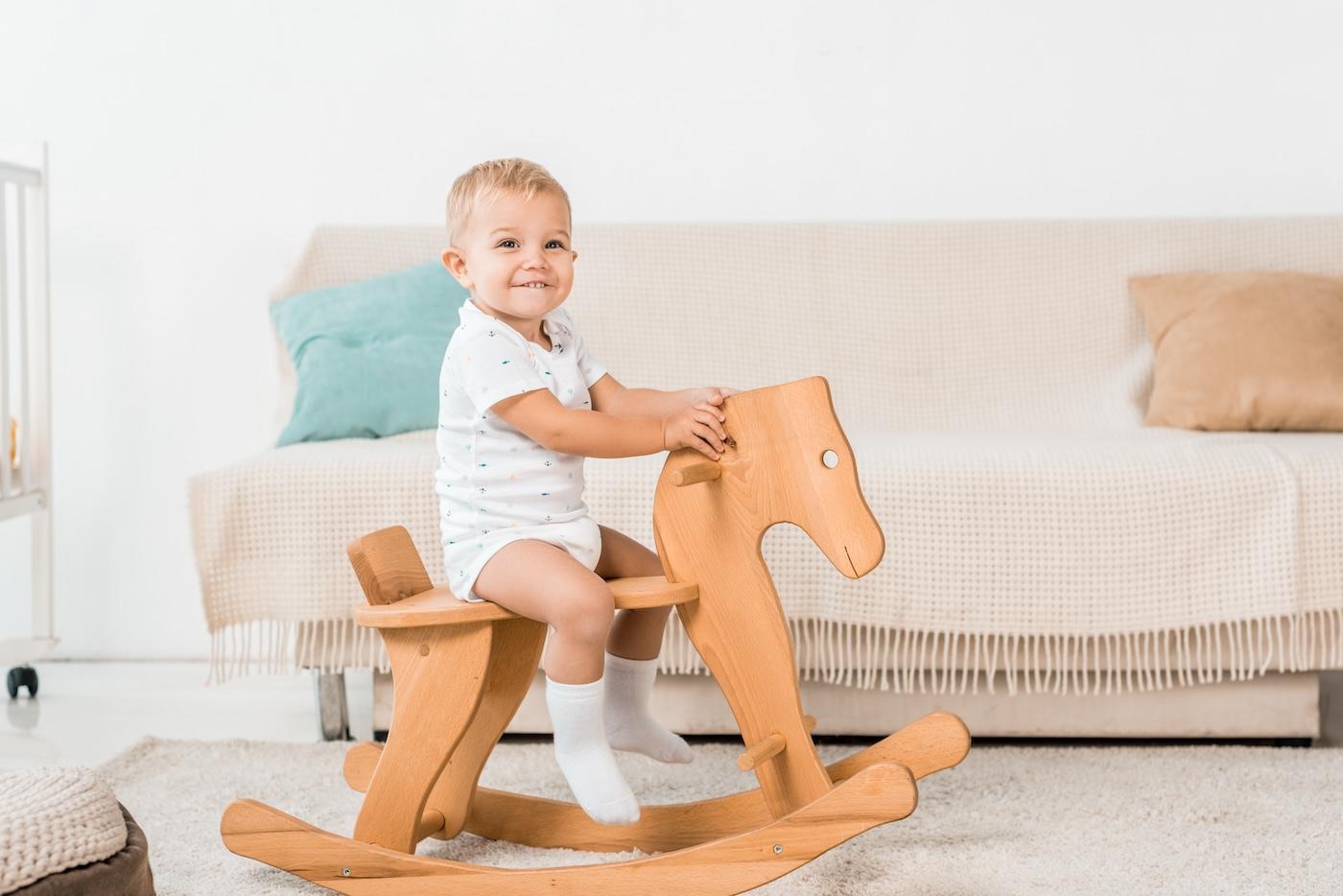
Fostering creative thinking in your child does not mean having several toys; it means cultivating variety for them. I am definitely a fan of keeping it simple. Introduce your baby to older kids to play with; bring her to new parks; put out containers to bang or turn cardboard boxes into tunnels; and give your crawling infant time outside to roll, climb, touch the grass, and even get a little dirty. All this builds her confidence to experiment, helping learning and creativity grow through toddlerhood and beyond!
Disclaimer: The information on our site is NOT medical advice for any specific person or condition. It is only meant as general information. If you have any medical questions and concerns about your child or yourself, please contact your health provider. Breastmilk is the best source of nutrition for babies. It is important that, in preparation for and during breastfeeding, mothers eat a healthy, balanced diet. Combined breast- and bottle-feeding in the first weeks of life may reduce the supply of a mother's breastmilk and reversing the decision not to breastfeed is difficult. If you do decide to use infant formula, you should follow instructions carefully.






SHARE THIS ARTICLE
PARENT PICKS
Bestsellers